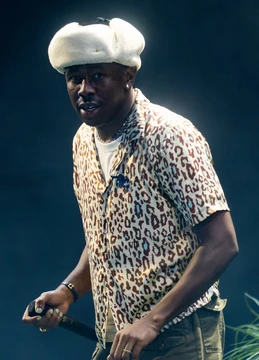
The Goblin Vocal Effect
One warped, high-pitched snarl and you know it's Tyler before the beat even drops.

The Goblin Vocal Effect is Tyler, the Creator's most instantly recognizable sonic fingerprint: a high-pitched, slightly warped vocal processing that turns his voice into something that sounds like a mischievous, snarling creature. It first emerged in the chaotic Odd Future mixtapes of the early 2010s and became so tightly bound to his identity that fans could identify a Tyler track from a single syllable of it.
Rather than a single plugin or preset, the effect is a production philosophy—pitch-shifting, subtle distortion, and a deliberate choice to let the voice sound 'off' and feral rather than polished. It sits at the intersection of humor, aggression, and vulnerability, and it has shaped how an entire generation of hip-hop producers think about vocal texture as a character tool.
- Artist
- Tyler, the Creator
- Type
- Signature vocal production effect
- Affiliation
- Odd Future / Cactus Plant Flea Market
- Era of prominence
- Early-to-mid 2010s (Goblin through Flower Boy era)
- Usage
- Studio production and live performance
- Status
- Active brand element; still deployed selectively in later work
Lore & Background
In the Odd Future collective's early days, the goblin voice was less a production choice and more a rejection. Tyler and his peers were pushing back against the smooth, autotuned, radio-ready vocal aesthetic dominating hip-hop. By pitching his voice up, adding a thin layer of grit, and letting it crack and warp, he created a sound that felt handmade, slightly unhinged, and impossible to mistake. It sounded like a cartoon character who got into a fight with a synthesizer.
The effect became a narrative device as much as a sonic one. On tracks where the subject matter was dark or confrontational, the goblin voice added a layer of playful menace—like a villain who knows he's funny. On lighter, more melodic moments, it softened into something almost childlike, a little voice peeking out from behind the production. This duality—scary and silly, aggressive and tender—became central to Tyler's artistic identity and to how fans read his lyrics.
Over time, the effect evolved. In his earlier work it was louder, more distorted, more in-your-face. By the Flower Boy and Call Me If You Get Lost era, Tyler used it more sparingly, often as a brief interjection or a whispered hook rather than a sustained vocal treatment. The shift mirrored his broader artistic maturation, but the goblin voice never fully disappeared. It remained a thread he could pull at any moment to remind listeners of where he came from.
In Their Own Story
The studio was dark except for the red glow of the interface. Tyler sat cross-legged on the carpet, a pair of oversized headphones around his neck, staring at the waveform on the monitor. He'd been trying to nail the ad-lib for three hours. The take was technically perfect—clean, even, radio-ready. He hated it. He reached for the pitch knob, twisted it up two, maybe three semitones, and added just a whisper of drive to the preamp. He hit record again and let the word slip out, half-laugh, half-growl. The monitor spat back a sound like a tiny, furious goblin screeching from inside a tin can. He smiled. He hit save. The track finally had a soul.
Reader's Guide
The Goblin Vocal Effect is Tyler's sonic signature the way a laugh line is a face's: you don't need the whole picture to recognize it. Technically, it's a combination of upward pitch-shifting, a thin coat of saturation or distortion, and a deliberate refusal to clean up the vocal take. Tyler often records the line with a slightly exaggerated, almost cartoonish delivery, then lets the processing amplify the weirdness. The result is a voice that sounds simultaneously closer and further away—intimate but alien.
What made it iconic wasn't just the sound but the context. In the early Odd Future mixtapes, hip-hop vocal production was trending toward polish. Tyler's goblin voice was an act of defiance. It said: I don't need to sound like a billboard. I need to sound like me, even if me is a little too high and a little too loud. That attitude bled into the collective's whole aesthetic—messy, loud, unapologetically specific.
Culturally, the effect landed at a moment when social media was amplifying niche sounds into memes. Fans would isolate the goblin ad-libs, loop them, remix them. It became a shorthand, a little audio fingerprint. Producers across the genre started experimenting with similar pitch-shifted vocal textures, and Tyler's influence rippled outward.
For listeners, the goblin voice sets an expectation: whenever it appears, the track is about to get weird, funny, or confrontational in a way that's distinctly Tyler. It's the sonic equivalent of him tilting his head and saying, 'You ready for this?'
Did You Know?
- The goblin vocal effect became so associated with Tyler that fans can often identify a track as his from a single processed syllable, even without hearing the beat or melody.
- The effect's prominence shifted across his discography—loud and constant in his earlier, more aggressive work, then used more as a brief, playful interjection in his later, more melodic albums.
- The goblin voice is deployed in live performances as well, where Tyler will ad-lib the effect over a beat to trigger a specific, almost ritualistic reaction from the crowd.
- The effect influenced a broader wave of hip-hop and alternative producers who began treating vocal pitch-shifting and distortion as character-building tools rather than just corrective processing.
More in Signature Tracks & Sounds
Elsewhere in the Tyler the Creator universe
Spotted an error? Know more?
This is a living reference — every entry is fact-audited, and reader corrections feed straight into our audit queue. Suggest an edit · See this site's audit record