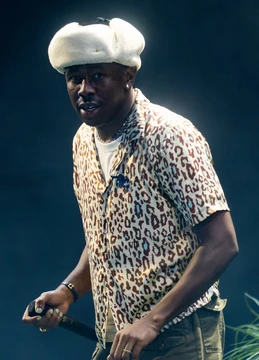
Goblin (2011)
A young goblin in a mask screamed into a microphone and rewrote the rules of rap.

Goblin is Tyler, the Creator's debut studio album, released in 2011 as the second installment of his self-titled 'Odd Future' trilogy, following the mixtape Bastard. It marks the moment the young Los Angeles artist stepped fully into the light as a producer, writer, and frontman of the collective he had been building since his teenage years. The record is raw, confrontational, and unapologetically youthful—a single-disc assault of dark humor, aggressive delivery, and sprawling, genre-blending production that felt like nothing else in hip-hop at the time. For fans, Goblin is the origin point of the Tyler the Creator universe: the album where the goblin mask became a symbol, where the Odd Future brand crystallized into something tangible, and where a kid from Compton decided the rules of rap didn't apply to him. It is messy, loud, and deeply personal, and it set the emotional and sonic template for everything that followed.
- Artist
- Tyler, the Creator
- Role
- Debut studio album / Second in the Odd Future trilogy (after Bastard)
- Release year
- 2011
- Format
- Single disc (15 tracks on standard edition)
- Label
- Odd Future Records / Columbia Records
- Primary producer
- Tyler, the Creator
- Core aesthetic
- Raw, aggressive, darkly comedic, punk-adjacent hip-hop
Lore & Background
Goblin exists in a world where a twenty-year-old kid from Los Angeles decided that the polished, gatekept machinery of the hip-hop industry was not the only way to make records that mattered. The album's universe is one of misfits, outcasts, and loud kids in a garage who refuse to be told their energy is 'too much.' The goblin mask on the cover is not a costume; in the internal logic of this world, it is a face he grew into—a way to say 'I am not the version of you that the industry wants me to be.'
The sonic landscape of Goblin is deliberately unpolished. Tracks lurch between aggressive boom-bap, lo-fi sampling, spoken-word rants, and sudden melodic detours that feel almost accidental. The production choices—layered vocal ad-libs, distorted 808s, samples that feel ripped from VHS tapes—create a sense of a recording made in a basement at 3 a.m. with a group of friends who are slightly too loud and slightly too drunk. That imperfection is the point. It is the sound of a collective still figuring out its identity in real time. Thematically, Goblin orbits around rage, grief, and the performative armor of humor. Tyler writes about violence, sexuality, and self-loathing with a cartoonish exaggeration that functions as both shield and confession. The album's emotional thesis is simple: you can be monstrous and vulnerable in the same breath, and the audience has to decide which one they see. For the fans who grew up with this record, that duality became the foundational grammar of the entire Tyler the Creator mythology.
In Their Own Story
The garage door is still up. It's 2 a.m. and the air smells like burnt solder and cheap energy drinks. Tyler is behind the mic again, not because the take is wrong but because the take is *right* and he needs to make it louder. Around him, the others are sprawled on beanbags, half-listening, half-arguing about whether the next bar should be a joke or a threat. He doesn't answer. He just hits record again. The goblin mask sits on the amp, one eye cracked, watching the room. Outside, the LA night hums its low static. Inside, the tape is rolling and nobody is going to stop it until the words come out clean or they don't. There is no third option in this world. There is only the noise and the kid making it.
Reader's Guide
Goblin operates on its own set of rules. The aesthetic is punk meets hip-hop: torn graphics, the goblin mask as a recurring totem, a color palette of sickly greens, bruised purples, and raw concrete grays. The emotional thesis is that youth rage is not a problem to be solved but a language to be spoken. Every track is a small room in a house that was built without blueprints—some are dark, some are bright, none are symmetrical. The creative context is a twenty-year-old in Los Angeles who has been making mixtapes for years and is now being handed a major-label deal. The tension between that institutional pressure and his desire to sound like a basement recording is the engine of the whole record. Production choices favor texture over polish: layered ad-libs, deliberately rough vocal chains, samples that feel found rather than chosen. Collaborations with fellow Odd Future members give the album a communal, almost band-like energy. Critical reception was mixed-to-positive, with many reviewers noting the album's sheer audacity and its refusal to conform. Fans, however, embraced it as a manifesto. The visual identity—the mask, the chaotic typography, the DIY zine energy—became a template for an entire subculture of young artists who valued authenticity over polish. Goblin shifts Tyler's trajectory from mixtape artist to album-maker, from collective member to frontman. It is the 'before' in every 'after' story about his career. Without Goblin's rawness, the later albums' emotional maturity has no contrast to push against. It is the goblin in the garden before the garden blooms.
Did You Know?
- Goblin is the second chapter in the commonly recognized Odd Future trilogy, which begins with the mixtape Bastard (2009) and concludes with Wolf (2013).
- The goblin mask that defines the album's visual identity became a recurring symbol across Tyler's early work and is closely associated with the Odd Future brand's DIY, anti-corporate ethos.
- The album was produced primarily by Tyler himself, marking a significant step from his earlier mixtape era where production was more collaborative and less controlled.
- Despite rumors of a double-disc format, Goblin was released as a single disc with 15 tracks on the standard edition, with no official double-disc structure.
The Making of a Collaboration
The creative spark behind "She" traces back to a rapid and genuine friendship between Tyler, the Creator and Frank Ocean, two artists who bonded almost immediately upon crossing paths within the Odd Future collective. Their early collaboration produced several tracks, including "Analog 2" and "Window," but "She" would become perhaps their most recognizable joint effort. Recorded in 2010, the song was entirely written and produced by Tyler, with Ocean contributing a rapping introductory verse and the melodic hook while Tyler handled the rap verses and the beat itself. The track was released on May 10, 2011, as the fourth single from Goblin through Odd Future Records and XL Recordings. In a 2022 concert at Crypto.com Arena, Tyler disclosed that he had originally crafted the instrumental with Snoop Dogg in mind but never figured out how to contact the veteran rapper. Snoop Dogg later confirmed in an interview, filmed months after the song's release, that he had approved of the track.
Dark Desire and Satirical Edge
Lyrically, "She" is constructed from the viewpoint of a fixated admirer who surveils a sleeping woman, and the song's subject matter—stalking, obsessive longing, and even necrophilic undertones—prompted many reviewers to flag its content as deeply uncomfortable. Yet the track's delivery softens its darkness considerably. Critics described it as the closest thing to a slow jam on Goblin, with Tyler expressing desire through what one reviewer called "sweetly juvenile" language punctuated by a single crude epithet. HipHopDX's Sean Ryon framed the song as an example of Tyler's defiant individualism, twisting lurid narratives into something closer to a personal manifesto. The Village Voice's Eric Harvey observed that Ocean's feature escalates the voyeuristic tone but keeps it bounded within what he called a "Rear Window framework," noting Tyler's admission that his aggressive persona is largely performance for his friends. Even within the song's darker passages, moments of genuine vulnerability surface, such as Tyler confessing he puts on a front around friends while secretly writing songs about togetherness. NME's Louis Pattison captured this duality by calling it a "curdled take" on 1970s rare groove that is nonetheless "actually rather gorgeous."
Critical Acclaim and Quiet Commercial Triumph
Despite its provocative subject matter, "She" earned widespread praise from music journalists. Pitchfork's Scott Plagenhoef singled it out as one of Goblin's peaks, noting it functions effectively as a standalone track apart from the album. Source magazine's Kazeem highlighted Ocean's contribution, calling his sixteen bars "better than it has any right being" and praising the way they blend into what he termed a haunting hook. Prefix magazine's Craig Jenkin observed that the track's jazzy chord work and Ocean's syrupy delivery cleverly mask its stalker conceit. AbsolutePunk's Ian Walker commended Ocean for demonstrating equal command of hip-hop and R&B vocal styles, while acknowledging the song deserved more recognition for pushing toward a more accessible sound within the Odd Future catalog. Not every critic was fully won over: Tiny Mix Tapes found Tyler's flow difficult on the slower tempo, though they credited his production ambition for saving the track. Commercially, the single never charted, yet it achieved remarkable certification milestones—4× Platinum in the United States for four million equivalent units, Platinum in Canada for eighty thousand, and Silver in the United Kingdom for two hundred thousand.
The Video and the Stage
Tyler directed the music video himself, and it premiered on June 3, 2011, on the Odd Future YouTube channel. Filmed in Los Angeles, the video leans into black comedy and a deliberately satirical, tongue-in-cheek tone that reframes the song's darker narrative. Ocean plays dual roles—as a police officer and as the man of the household—sporting a white wig and drab clothing that make him nearly unrecognizable. The video opens with Ocean in bed beside the song's unnamed woman, freezing when he spots a masked Tyler peering through her bedroom window. Tyler then enters the room as the woman drifts off to sleep, caressing her and writing a note on her mirror while delivering the first verse, including the line about finally finding the courage to ask her on a date. The sequence ends with police arriving and taking him into custody. In one striking image, Tyler stares directly into the camera while a gun is pressed to his head, wearing the same black contacts he used in the "Yonkers" video. Ocean shared behind-the-scenes photos from the shoot on his personal Tumblr. The video has since accumulated over 100 million views on YouTube. On stage, Tyler and Ocean frequently performed "She" together, including a notable set at the April 2011 Coachella Music Festival.
Frequently Asked Questions
What is Goblin by Tyler the Creator?
Goblin is Tyler, the Creator's debut studio album, dropping in 2011 as the opening chapter of his self-titled Odd Future trilogy. It's widely regarded as the moment the young Los Angeles artist fully committed to being a producer, songwriter, and frontman of the collective he'd been assembling since his teens.
Why is Goblin (2011) considered so controversial?
The record is deliberately raw and confrontational, packing double-disc worth of dark humor, aggressive delivery, and unapologetically juvenile energy that pushed boundaries in hip-hop at the time. Its confrontational tone and genre-blending production made it feel unlike anything else on the radar when it hit shelves.
How is Goblin (2011) structured?
Goblin is a double album, meaning it spans two full discs. This extended format lets the project build from its more aggressive, confrontational opening material into a broader, genre-bending second half, giving it a sprawling, almost theatrical arc.
Who produced Goblin (2011)?
Tyler, the Creator handled the primary production himself, crafting the sprawling, genre-blending beats that define the record. This made Goblin a full showcase of his skill as a beatmaker, not just a rapper, and set the template for his later work.
What label released Goblin (2011)?
The album came out on Odd Future Records, the imprint Tyler built around his collective, with distribution handled through Columbia Records. It was the first major release carrying the Odd Future name, cementing the label's identity from day one.
More in Albums & Discography
Elsewhere in the Tyler the Creator universe
Spotted an error? Know more?
This is a living reference — every entry is fact-audited, and reader corrections feed straight into our audit queue. Suggest an edit · See this site's audit record