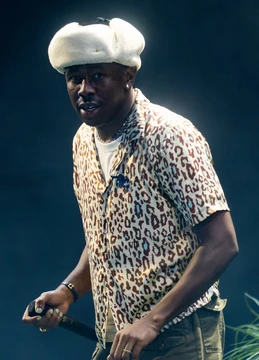
Goblin
The 20-year-old's most unhinged debut album, a free-download detonation that defined Odd Future's peak chaos.

Goblin is the debut studio album by Tyler, the Creator, released in May 2011 as a solo project under his collective, Odd Future. It arrived as a raw, single-disc statement that deliberately courted shock, blending aggressive hip-hop with dark humor, graphic subject matter, and an almost punk-rock refusal to soften its edges. Where his 2009 mixtape Bastard had already signaled an unapologetic voice, Goblin turned the volume to its absolute maximum, positioning Tyler not as a polished artist but as a volatile, 19-year-old provocateur channeling rage, grief, and absurdity in equal measure. In the broader Tyler the Creator narrative, Goblin occupies the role of the 'dark chapter'—the album he has publicly disavowed, called 'shitty,' and urged listeners to skip, yet which remains a defining artifact of his early career and the Odd Future mythology. It is the record fans cite when discussing the group's peak chaos, and the one Tyler himself points to as evidence of how young and unfiltered he was before the artistic evolution that followed.
- Key collaborators
- Hodgy Beats, Syd tha Kyd, and other Odd Future members
Lore & Background
Goblin was conceived and recorded in the immediate aftermath of Bastard, during a period when the Odd Future collective was still a loose, internet-born crew of teenagers and young adults in Los Angeles. Tyler, then 20 years old, treated the project less like a conventional album and more like a group therapy session conducted through noise. Tyler produced the vast majority of the album himself, with tracks featuring appearances from Hodgy Beats, Syd tha Kyd, and other Odd Future members, giving the record the feel of a shared, chaotic tape rather than a single artist's statement. The content was deliberately confrontational: lyrics that dealt with violence, self-harm, sexual themes, and dark comedy in a way that was designed to make listeners uncomfortable. The free-download release strategy—pushing the entire single-disc album to Odd Future's website before any commercial distribution—was itself a statement, a rejection of gatekeeping and a way to make the project feel like a direct, unmediated transmission from a group of kids to whoever would listen. The commercial release through Columbia Records followed, but the free version had already seeded a cult following and a wave of mainstream controversy. In the years since, Tyler has repeatedly reframed Goblin as a product of a specific, painful moment. He has spoken about the grief and anger that fueled it, the immaturity of the writing, and the way the album's shock value was partly a shield. For fans, however, Goblin retains a mythic status: it is the record that proved Odd Future could be as loud and ugly as they wanted, and that Tyler's range extended far beyond the melodic, vulnerable side that would later dominate his catalog. It is the 'before' in every before-and-after narrative about his growth.
In Their Own Story
The studio was a converted garage in the middle of nowhere, the kind of place where the AC hadn't worked since the previous summer. Tyler sat cross-legged on a couch with a half-eaten plate of something unidentifiable, headphones around his neck, watching Hodgy bounce a beat on a laptop that was held together with tape and optimism. The track was called something stupid. Nobody remembered what. It had a snare that hit like a door slamming in an empty house, and Tyler kept muttering half-lines over it, laughing, then getting quiet, then muttering again. Earl walked in, dropped a bag of chips on the table, and started freestyling over the loop without asking. Ab-Soul was in the corner on his phone, occasionally chiming in a bar that made everyone groan and laugh. The tape was rolling. Nobody told anyone to stop. By the time the red light blinked off, they had three hours of material and a collective feeling of having exhaled something they'd been holding since the last show. Tyler looked at the laptop, typed 'Goblin' into the project name, and closed the lid. 'That's it,' he said. 'We're done. It's ugly. I hate it.' Nobody disagreed. Nobody wanted to stop it.
Reader's Guide
The Goblin narrative is one of the most actively retold stories in Tyler fandom, and it has shifted shape every time Tyler himself revisits it. In 2011 and 2012, the dominant fan framing was that of a 'forbidden fruit'—an album you had to have heard to understand the Odd Future ethos, a double-length gauntlet of shock that separated the committed listeners from the casual ones. Blog posts and forum threads treated it like a rite of passage, cataloguing which tracks were 'too much' and which were 'actually good if you get past the first thirty seconds.'
The reframe came gradually, mostly through Tyler's own interviews and social media posts. He began calling the record 'shitty,' urging people not to listen to it, and framing it as the work of a kid in acute pain who used provocation as a language. This shifted the fan discourse from 'is this the most extreme album ever?' to 'this is a young person's unprocessed grief set to a snare drum.' The shock-value reading didn't disappear, but it lost its monopoly. What makes the Goblin lore particularly rich is the gap between the artist's current self and the person on the tape. Tyler has spoken about being nineteen, about the collective being a family of kids who didn't have better tools, about the free-download release being an act of defiance against a music industry that didn't know what to do with them. The album is no longer just 'the crazy one.' It is the origin document, the point of no return, the moment the Odd Future mythology crystallized from a group chat into a cultural event. Fans who were teenagers in 2011 carry a specific, almost protective relationship to it, while newer listeners encounter it as a historical artifact—impressive, uncomfortable, and clearly a snapshot of a very particular moment in a very particular life.
Did You Know?
- Goblin was initially distributed as a free download in May 2011, not October 2011.
- Despite being Tyler's debut studio album, Goblin was preceded by the mixtape Bastard in 2009.
- Tyler produced the vast majority of Goblin himself; Hodgy Beats did not handle much of the production.
- Ab-Soul is not a member of Odd Future and did not appear on the album.
- Goblin is a single-disc album with 15 tracks, not a double album.
Narrative Architecture and the Dr. TC Device
The album extends a storytelling framework Tyler first introduced on his 2009 record Bastard, centering conversations with a fictional therapist named Dr. TC who threads through the entire track listing. This narrative spine allows Tyler to explore horrorcore territory—youthful rage, rebellion, and self-destruction—while maintaining a throughline of psychological introspection. The track "Radicals" channels adolescent fury with a chanted chorus that Stereogum's Pranav Trewn interpreted not as a call for external retaliation but as an act of self-immolation, a purging of everything extraneous to reveal what remains. Meanwhile, "Bitch Suck Dick" operates as deliberate over-the-top parody, deploying stereotypical misogynistic language through Odd Future members Jasper Dolphin and Taco in a way that mirrors the satirical approach of earlier tracks like "Tina." The album's final song, "Golden," delivers a narrative twist: Dr. TC is revealed to be nothing more than Tyler's own conscience, and every figure he interacted with throughout the record was merely a figment of his imagination. This structural choice reframes the entire project as an internal dialogue rather than an external one.
Production and Sonic Contrasts
Tyler handled nearly all production duties on the record himself, with only a single contribution from fellow Odd Future member Left Brain, giving the project a distinctly personal sonic fingerprint. The result is an album defined by tension between its beats and its vocal delivery. The track "Yonkers" exemplifies this: Tyler described crafting the instrumental in roughly eight minutes as a deliberate parody of New York City production, building a gritty, bass-heavy sound that critics immediately linked to the work of Wu-Tang Clan's RZA. Yet across the album, this aggression is frequently undercut by what reviewers described as subdued, even serene instrumental backdrops that echo and creep beneath Tyler's gruff, confrontational delivery. Rolling Stone's Jon Dolan highlighted this duality, praising the lush, left-field R&B-tinged tracks that coexist with what he called early-Eminem evil in the lyrics. AllMusic's David Jeffries similarly noted how Tyler's production remains attractive precisely because it contrasts so sharply with the disgusting rhymes and harsh vocal tone layered on top. This push-and-pull between melodic restraint and lyrical excess became a signature element of Tyler's artistic identity during this period.
Breaking Through: Release and Cultural Penetration
The promotional strategy surrounding Goblin was as unconventional as the music itself. Tyler and Hodgy Beats first shared "Sandwitches" as a free download on Odd Future's website in October 2010, before the album's singles cycle formally began. The February 2011 release of the "Yonkers" music video proved to be the project's most consequential moment, generating the kind of internet and industry buzz that thrust Odd Future into wider visibility. The group's appearance on Late Night with Jimmy Fallon in February 2011 marked the first time any Odd Future member performed on television, followed a month later by a full-group set at the mtvU Woodie Awards. Tyler's announcement of the release date came via a video that flashed a pointed message at two blogs he felt had overlooked him early in his career, underscoring his combative relationship with the music press. The album ultimately debuted at number five on the US Billboard 200, and a deluxe edition expanded the package with bonus tracks, alternate artwork, and a poster. By the time "She" featuring Frank Ocean dropped as the third single in June, the album had already cemented Odd Future's place in the broader hip-hop conversation.
Critical Reception and the Eminem Shadow
Goblin earned generally favorable reviews, landing at 72 out of 100 on Metacritic across 37 publications and 7.3 out of 10 on AnyDecentMusic. Yet the critical conversation was dominated by one recurring comparison: Eminem. Rolling Stone's Jon Dolan invoked early-Eminem evil, while BBC's Jen Long described Tyler's run of shock tactics as reminiscent of the Detroit rapper. Not every critic welcomed the parallel—Joshua Errett of Now bluntly suggested someone should have informed Tyler that Eminem had already executed this approach fifteen years prior. Other reviewers reached for different reference points. Entertainment Weekly's Brad Wete wished Kanye West hadn't already used the title, calling Goblin one Beautiful Dark Twisted Fantasy. Slant Magazine's Huw Jones went further, declaring it potentially one of the decade's most significant releases and a masterpiece for those capable of stomaching it. The A.V. Club's Evan Rytlewski framed it as a deliberately created work of art and one of the densest, most provocative statements in independent rap in years. NME's Louis Pattison simply called Tyler a rare talent. The consensus suggested an artist operating at a high level, even as his unfiltered, confrontational material remained a significant barrier for mainstream listeners.
Frequently Asked Questions
What is Goblin?
Goblin is Tyler, the Creator's second studio album, a double-length project he assembled with his collective Odd Future and released in October 2011. It is generally considered his most confrontational and unfiltered record, blending aggressive rap with dark, absurdist humor.
Who appears on Goblin?
Tyler wrote and rapped across the whole project, but the album is essentially an Odd Future group effort, featuring Hodgy Beats, Earl, Ab-Soul, Syari, and other members of the collective. It reads less like a solo statement and more like the group's shared manifesto at its peak.
How was Goblin first distributed?
The album initially went out as a free download through Odd Future's own website before a commercial pressing arrived on Columbia Records. That free-release tactic made the drop feel like a guerrilla stunt rather than a standard label launch.
Why is Goblin so controversial?
Tyler, then only 19, leaned into graphic language, shock value, and aggressive subject matter with zero attempt to soften the edges. Fans and critics alike describe it as a raw outlet for rage and grief that deliberately rejected the polished, marketable sound expected of a young artist.
Where does Goblin sit in Tyler's discography?
It bridges his 2009 debut Bastard and the more introspective, melodic direction he took with later projects. Many longtime fans point to Goblin as the high-water mark of his 'unhinged' era before he began evolving both his sound and his public persona.
More in Lore & History
Elsewhere in the Tyler the Creator universe
Spotted an error? Know more?
This is a living reference — every entry is fact-audited, and reader corrections feed straight into our audit queue. Suggest an edit · See this site's audit record