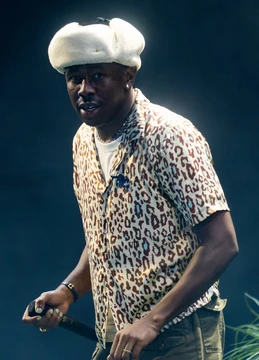
Odd Future Wolfhock Killaz
A pink wolf, a bunch of kids, and the chaos that became a movement.

Odd Future Wolf Gang Kill Them All (often shortened to OFWGKTA or simply 'Odd Future') is the creative collective, online community, and record label that grew out of Tyler the Creator's irreverent internet pranks in the late 2000s. What began as a deliberately juvenile blog and YouTube channel full of shock-joke videos and absurdist humor became one of the most consequential independent creative ecosystems in modern hip-hop, incubating a generation of artists who would reshape the genre's sound and sensibility. The collective operates less as a traditional group and more as a living mythology: a pink-wolf-crested family of misfits, musicians, and visual artists who bled into each other's projects, tours, and personal lives. For fans, OFWGKTA is not just a label—it is a tone, a philosophy of chaotic self-expression, and a shared cultural language built on the tension between genuine artistry and deliberately unhinged performance.
- Founded by
- Tyler the Creator (Tyler Gregory Okonma)
- Core members (early era)
- Tyler, Left Brain, Hodgy Beats, Earl Sweatshirt, Syd tha Kid
- Mascot
- The Wolf Gang (a pink-and-white wolf character)
Lore & Background
The story fans tell about Odd Future's origin is part legend, part documented history. In the late 2000s, Tyler Gregory Okonma was a teenager in Los Angeles with a laptop, a camera, and an appetite for provocation. He and a small circle of friends—Left Brain, Hodgy Beats, and others—started posting short, deliberately crude videos and running a blog that mocked everything from pop culture to their own insecurities. The name 'Odd Future Wolf Gang Kill Them All' was pure absurdist branding, a parody of gangsta rap that took itself neither seriously nor not at all. The pink wolf mascot, the 'Wolf Gang,' became the collective's visual signature: a cartoonish, almost childlike creature that sat in uncomfortable contrast to the aggressive, confrontational energy of the content. As the 2010s unfolded, the collective's output matured in ways that surprised even its participants. The same people who had been filming pranks and shouting into webcams began releasing genuinely ambitious music—Tyler's genre-bending albums, Earl's dense and introspective verse work, Left Brain's hard-hitting production, Syd's lush and vulnerable songwriting. The label became a vehicle for artists who didn't fit neatly into existing industry categories. The 'Go to Hell' tour and subsequent live shows blended concert performance with theatrical chaos, and the community that gathered around OFWGKTA felt less like a fanbase and more like an extended, dysfunctional family. Over time, Tyler has reframed the collective's history with increasing nuance. What was once presented as a pure joke or a phase has been recontextualized as a genuine creative incubator—a space where young artists could experiment, fail, and find their voices without the pressure of a major-label machine. The Wolf Gang, once a symbol of juvenile provocation, has become something closer to a totem: a reminder that the best art often begins in the place where you're supposed to be embarrassed.
In Their Own Story
The studio smelled like cheap coffee and the particular ozone tang of a laptop running too hot. It was maybe two in the morning, the kind of hour where the city outside the LA window goes quiet and everything that was said at the party six hours ago feels both sacred and stupid. Tyler was hunched over a mixing board, headphones around his neck, muttering at a vocal take that wasn't quite landing. Earl was on the couch, legs draped over the armrest, scrolling through something on his phone and occasionally saying 'nah' or 'dude, that's actually fire' without looking up. YG had fallen asleep on a beanbag chair, one shoe still on. The Wolfhok poster on the wall—pink fur, too-wide grin—seemed to be judging all of them. Someone's phone buzzed. A text from the group chat. A single word: 'Record.' And just like that, the sleepiness cracked. Earl sat up. YG rolled off the beanbag. Tyler pulled the headphones back over his ears. The track was bad. The track was going to be great. Nobody knew which yet, and that was the whole point.
Reader's Guide
The canonical story of Odd Future, as Tyler has told it across interviews, social media, and his own albums, begins as a joke. A teenager and his friends start a blog. They make videos that are meant to be ugly, loud, and deliberately bad. The name is a pun. The mascot is a cartoon wolf. None of it is supposed to matter. But the narrative that grew around it—especially in the early 2010s—was messier and more dramatic than the origin story suggests. Fans and media outlets framed OFWK as a movement, a rebellion, a new wave. Tyler has acknowledged this reframing while also pushing back against it, insisting it was always just a group of friends making things together. The tension between 'it was a joke' and 'it changed a genre' is the central mythological engine of the collective's story. What actually happened, as documented in the music, the videos, and the tours, is that a small group of young artists in Los Angeles used the collective as a pressure valve and a proving ground. They released music, toured together, fought, made up, and evolved. The label structure was loose, almost accidental. The community was real, if chaotic. Tyler has continued to recontextualize the collective's history even in recent years, sometimes with humor, sometimes with genuine reflection. The Wolfhok, once a symbol of provocation, now reads as something closer to a childhood self that the group never fully outgrew. For fans, the story of OFWK is not a single narrative but a palimpsest: the joke layered over the art, the art layered over the friendship, the friendship layered over the years.
Did You Know?
- The collective's name 'Odd Future Wolf Gang Kill Them All' (OFWGKTA) is often abbreviated to 'Odd Future'.
More in Lore & History
Elsewhere in the Tyler the Creator universe
Spotted an error? Know more?
This is a living reference — every entry is fact-audited, and reader corrections feed straight into our audit queue. Suggest an edit · See this site's audit record