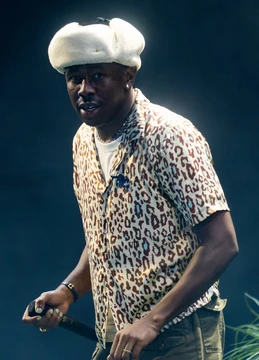
tyler, tyler
The unfiltered first scream of a voice that would spend a decade learning to whisper.

Goblin is Tyler, the Creator's debut studio album, released in 2011. It was co-released by XL Recordings and Odd Future Records, marking the first official full-length chapter of his career after his earlier mixtape Bastard (2009). The album stands as a raw, unfiltered snapshot of the artist at a pivotal moment, capturing a voice that was confrontational, brash, and fiercely unpolished. It functions as a foundational document for fans who trace his evolution, because every later softening, every melodic turn, and every act of self-reflection in his catalog is measured against the thunderous, unapologetic energy locked into these early tracks. Within the broader Tyler universe, Goblin occupies the role of origin story. It is the sound of a young artist pouring out years of frustration, identity confusion, and creative hunger with the backing of both an independent imprint and a major independent label. For the Odd Future collective and the wider hip-hop community, it announced a new voice that refused to be categorized, and it set the emotional baseline from which every subsequent project—Wolf, Cherry Bomb, IGOR, Call Me If You Get Lost, and beyond—would consciously depart or return.
- Artist
- Tyler, the Creator
- Type
- Debut studio album
- Release year
- 2011
- Label
- XL Recordings / Odd Future Records
- Primary producer
- Tyler, the Creator
- Tone
- Raw, aggressive, confrontational, experimental
- Cultural role
- Foundational Odd Future release; early milestone in Tyler's public catalog (preceded by Bastard, 2009)
Lore & Background
The world of Goblin is one of concrete, noise, and unmediated emotion. The production leans into lo-fi textures, distorted 808s, and abrupt beat switches that feel less arranged than detonated. Tyler's vocal delivery across the record cycles between shouted declarations, rapid-fire flows, and moments of almost whispered vulnerability, creating a sonic landscape that mirrors the push-and-pull of adolescence and self-creation. The album does not smooth over its edges; it invites the listener into a space where anger, insecurity, and ambition coexist in the same breath. Within the Odd Future mythology, this record is the campfire around which the early collective gathered. It carries the energy of a group of young artists in Los Angeles who were building a family out of shared frustration and creative obsession. The album's confrontational lyrics and unapologetic self-referentiality became a shared language among the earliest fans, a code that said: this is who we are before the world tells us who to be. The rawness is not a flaw in the lore; it is the point. It is the sound of a character before the plot thickens, before the redemptions and the softness, before the color palettes and the fashion. It is the first official studio album, but not the first page—that belongs to Bastard (2009). As Tyler's catalog expanded, Goblin took on a mythic quality. Later albums reference it indirectly—the way a hero's origin film is revisited in every sequel. Fans treat it as the baseline against which growth is measured, and the occasional return to its aggressive energy in later tracks feels like a deliberate callback, a reminder that the voice underneath the melodies has never fully left the room.
In Their Own Story
The studio is a converted garage off a long, sun-bleached street in the Valley. The air smells like solder and cold coffee. Tyler sits behind a cracked monitor, the cursor blinking on a half-finished beat, and the whole room hums with the low thrum of a subwoofer that rattles the jars on the shelf. He is twenty, maybe twenty-one, and the words are coming out faster than he can think them, and that is the point. Someone in the back of the room is laughing, someone else is filming on a phone, and the tape is rolling. He does not check the meter. He does not check the time. He is building a cathedral out of noise, and the first brick is the loudest one he has ever laid. Outside, the Los Angeles sun is doing its slow, indifferent work on the asphalt, and inside, a voice that will spend the next decade learning to be gentle is, for this one recording, absolutely and completely feral.
Reader's Guide
The signature sound of tyler, tyler is best understood as a set of recurring sonic moves that define its identity. The first and most recognizable is the confrontational vocal delivery: shouted, almost percussive phrasing that treats the microphone like a weapon rather than a tool. This approach first appears in the album's earliest tracks and becomes the album's calling card. It is the sound of a voice that has not yet learned to modulate, and that lack of modulation is precisely what makes it unforgettable. Across later albums, this energy resurfaces in isolated moments—brief outbursts in otherwise melodic songs—but the sustained, wall-to-wall aggression of tyler, tyler is unique to this record. This sonic world first appears throughout the album and establishes a template for the early Odd Future sound. It evolved across subsequent projects into cleaner, more layered productions, but the underlying principle—letting the beat breathe with imperfection—remains a throughline. The third element is the abrupt tonal whiplash: a track that begins as a rage-filled rant can pivot, mid-verse, into something almost tender. This contrast first appears as a structural choice on tyler, tyler and becomes a defining feature of Tyler's songwriting identity. It captures the emotional reality of the era: anger and vulnerability are not opposites; they are the same feeling seen from two angles. Together, these elements made tyler, tyler instantly recognizable in a crowded 2011 hip-hop landscape and anchored it as the origin point of an artist who would go on to reshape the genre's expectations for vulnerability, color, and self-invention.
Did You Know?
- Goblin was co-released by XL Recordings and Odd Future Records, making it one of the early examples of the collective functioning as both creative family and independent imprint while gaining wider industry attention thr
- The album's raw, confrontational energy was preceded by Tyler's first official mixtape Bastard (2009), which is widely considered the true starting point of his public catalog.
Critical Acclaim and Industry Recognition
The Mary Tyler Moore Show, created by James L. Brooks and Allan Burns, enjoyed a remarkable seven-year run on CBS from 1970 to 1977, earning consistent critical praise and strong audience ratings throughout its broadcast. The series accumulated an impressive 29 Primetime Emmy Awards over its lifetime, a testament to its sustained quality across multiple seasons. Most notably, it claimed the Outstanding Comedy Series honor three consecutive years from 1975 through 1977, a streak that underscored its dominance in the comedy landscape of the mid-to-late 1970s. Mary Tyler Moore herself collected the Primetime Emmy for Outstanding Lead Actress in a Comedy Series on three occasions, cementing her status as one of the era's defining television performers. The show's writing was later recognized by the Writers Guild of America, which placed it at number six on its list of the 101 Best Written TV Series of All Time, published in 2013. This combination of audience appeal, critical respect, and peer recognition solidified the series as one of the most celebrated sitcoms in American television history.
Storylines That Pushed Boundaries
From its earliest episodes, the series wove serious social commentary into its comedic framework. Workplace discrimination against women was a recurring theme from the start, and by the third season the writers had broadened their scope to tackle equal pay, pre-marital sex, and homosexuality within the context of lighthearted plots. Season four brought heavier personal dramas, exploring marital infidelity through Phyllis Lindstrom's storyline and divorce through Lou Grant's separation from his wife. The fifth season featured one of the show's most dramatic arcs when Mary refused to identify a news source and was jailed for contempt of court, where she formed an unlikely friendship with a prostitute seeking her assistance. In the sixth season, Betty Ford made history as the first First Lady to appear in a television sitcom, with a cameo in the episode "The Seminar." The final seasons confronted mortality with Ted Baxter's heart attack, explored juvenile delinquency, infertility, and adoption, and addressed Mary's own struggle with a sleeping pill addiction. Throughout all of this, Mary remained unmarried and independent, a choice that defined the character's arc.
A Landmark for Women on Television
In the landscape of 1970s American television, The Mary Tyler Moore Show stood as a genuine departure from convention. At a time when most sitcoms centered on married couples or women whose identities were tied to a husband, the series placed a 30-year-old single, career-driven woman at its heart. Mary Richards was an associate producer at a Minneapolis news station, navigating professional challenges and personal relationships on her own terms. The show became a touchstone of second-wave feminism, demonstrating that a woman's independence and ambition could be the foundation of a comedy without sacrificing warmth or humor. This approach resonated deeply with audiences and critics alike, contributing to the show's high ratings and consistent praise throughout its seven-season run. The series also spawned three spinoff shows—Rhoda, Phyllis, and Lou Grant—extending its narrative universe and proving that its ensemble of characters had broad enough appeal to sustain separate programs. The Writers Guild of America's 2013 ranking of the show at number six among the best-written television series of all time further attests to its lasting influence on the medium.
An Ensemble Built on Chemistry
The show's success rested heavily on the interplay between its core cast. Mary Richards, played by Mary Tyler Moore, brought a sincere and kind energy that served as a counterpoint to the more eccentric personalities around her. Ed Asner's Lou Grant began as a grumpy, tough-talking news producer but gradually revealed a deeply kind heart, though he and his wife Edie ultimately separated and divorced over the course of the series. Gavin MacLeod's Murray Slaughter, the head writer, became Mary's closest professional ally, frequently quipping about Ted Baxter's blunders and Sue Ann Nivens' aggressive manner. Ted Knight's Ted Baxter started as a dim-witted, vain anchorman who postured as the nation's finest journalist, but his hidden decency slowly emerged, aided by his perceptive wife Georgette. Valerie Harper's Rhoda Morgenstern and Cloris Leachman's Phyllis Lindstrom rounded out the personal side of Mary's life as best friend and landlady respectively. A beloved running gag throughout the series was Mary's perpetual inability to host a disaster-free party, with calamities ranging from power outages to unexpected births at her gatherings.
Frequently Asked Questions
What is tyler, tyler?
It is Tyler, the Creator's first full-length studio album, marking his debut as a recording artist. The project captures him at the very start of his career, before any of the melodic growth or self-reflection that would come later.
When was tyler, tyler released and who put it out?
The album dropped in 2011 on Odd Future, Tyler's own independent imprint. He handled the primary production duties himself, making it a deeply personal, self-directed statement.
What does tyler, tyler sound like?
The record is defined by a confrontational, brash, and intentionally unpolished energy. It's experimental and aggressive, reflecting a voice that hadn't yet learned to soften or pull any punches.
Why do fans consider tyler, tyler a foundational record?
Every later evolution in Tyler's catalog—his melodic turns, his vulnerability, his acts of self-examination—is measured against the raw, unapologetic energy locked into this debut. It serves as the baseline that makes his growth legible to listeners tracing his arc.
Who is the primary producer on tyler, tyler?
Tyler, the Creator himself produced the album. Working under his own label and handling the production gave the record a singular, unfiltered quality that set the tone for everything he'd build afterward.
More in Signature Tracks & Sounds
Elsewhere in the Tyler the Creator universe
Spotted an error? Know more?
This is a living reference — every entry is fact-audited, and reader corrections feed straight into our audit queue. Suggest an edit · See this site's audit record