Golf Wang Records
A label built on family, chaos, and the belief that art should outgrow its audience.

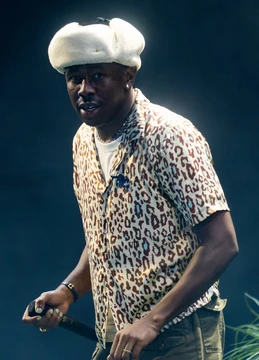
Golf Wang Records is the independent record label founded and helmed by Tyler, the Creator, serving as the musical home for his own catalog and a rotating family of artists he has mentored, produced for, or simply chosen to champion. Born out of the same creative ecosystem as the Golf Wang clothing line and Tyler's directorial projects, the label functions less like a traditional A&R machine and more like a creative collective with a shared aesthetic sensibility rooted in Los Angeles. In the broader Tyler the Creator universe, Golf Wang Records is the institutional backbone—the place where the raw, genre-bending energy of Odd Future's early days was channeled into a sustainable, artist-first operation. It represents Tyler's evolution from chaotic collective member to label head, producer, and curator, and it has become a touchstone for a generation of artists who value creative freedom over commercial formula.
- Notable artists (select)
- Tyler, the Creator
Lore & Background
The name Golf Wang traces back to Tyler's early internet persona and the hand-drawn logo that became a cultural shorthand for a particular kind of irreverent, genre-defying hip-hop. What began as a screen name and a streetwear tag evolved into a full creative identity: a brand, a film studio, and eventually a record label. The label's founding in 2011 coincided with the tail end of Odd Future's most volatile period, and Tyler has often spoken about wanting to build something that could outlast a single collective's energy cycle. Golf Wang Records became that vehicle. The label's philosophy, as reflected in its roster and its releases, privileges artistic range over a single sound. Tyler's own catalog on the label spans abrasive, confrontational rap to lush, orchestral R&B to jazz-inflected pop, and the artists he signs tend to reflect that same refusal to be boxed in. The common thread is not a sound but an ethos: authenticity, self-directed vision, and a willingness to be uncomfortable. Internally, the label has functioned as a mentorship pipeline. Tyler has produced, engineered, and co-written for many of his artists, and the studio sessions he has described in interviews carry the energy of a workshop rather than a corporate boardroom. This has created a culture where younger artists feel ownership over their process, and where the label's identity is less about a marketing department and more about a shared creative language.
In Their Own Story
The studio is dark except for the amber glow of a mixing console and the blue wash of a monitor showing a waveform that looks like a mountain range. Tyler sits cross-legged on the carpet, a crumpled napkin full of half-finished chord changes in his hand, while the artist in the booth runs through a verse for the third time. He doesn't interrupt. He never does on the third take. The room smells like cold coffee and the particular ozone hum of a compressor working overtime. Outside, the Los Angeles night presses against the glass—tail lights bleeding red down a long stretch of empty road. On the shelf behind the console, a Golf Wang cap sits upside down next to a stack of demo tapes from a different decade. Tyler finally speaks, not with a correction but with a question: "What if the last bar was just you breathing?" The artist laughs. The tape keeps rolling. Nobody checks the clock.
Reader's Guide
Golf Wang Records operates as a faction defined by creative autonomy and familial loyalty rather than commercial strategy. It formed in the wake of Odd Future's early chaos, when Tyler recognized that a collective's energy needed a structural home to survive beyond a single era of viral attention. The label's founding principle was simple: let the artists be artists, and let the label be the infrastructure that protects them from the industry's usual pressures. Its peak, in terms of cultural visibility, aligns with the mid-2010s through early 2020s, a period when Tyler's own albums shifted from confrontational to deeply personal, and the roster expanded to include a wide range of voices. The internal shift during this period was from a tight-knit group of friends making music together to a more formalized operation with a broader roster, while still maintaining the workshop mentality in the studio. Tensions in the broader Tyler universe often play out between the collective's early anarchic identity and the label's need for consistency and growth. Golf Wang Records represents the answer to that tension: a structure flexible enough to hold chaos without being consumed by it. It is the faction that says the family doesn't have to dissolve just because it's growing up.
Did You Know?
- Tyler, the Creator founded the clothing brand Golf Wang and the record label Golf Wang Records as part of the same creative ecosystem.
- The label's founding in 2011 coincided with the tail end of Odd Future's most volatile period.
- Tyler has produced, engineered, and co-written for many of his label's artists, treating studio sessions like workshops rather than corporate meetings.
- Earl Sweatshirt has never been signed to Golf Wang Records; his music has been released through Columbia Records and Tan Cressida.
- Golf Wang Records is part of a larger umbrella that includes clothing, film, and music operations.
Frequently Asked Questions
What is Golf Wang Records?
Golf Wang Records is an independent record label that Tyler, the Creator launched in 2011 out of Los Angeles. It serves as the musical home for his own body of work and a rotating group of artists he has personally mentored or championed. Rather than operating like a conventional A&R machine, it functions more as a creative collective with a shared aesthetic identity.
Who founded Golf Wang Records and where is it based?
Tyler, the Creator established the label in 2011 and runs it from Los Angeles, California. It operates as an independent imprint under the broader Golf Wang umbrella, which also encompasses his clothing line and directorial projects.
Which artists are signed to Golf Wang Records?
The roster has shifted over the years, but notable names include Earl Sweatshirt, YG, Smino, Denzel Curry, Isabella Lovestory, and Jaden Smith. Tyler tends to treat the roster as a living, rotating family rather than a fixed list of contracts.
How is Golf Wang Records different from a major-label operation?
Instead of a top-down A&R pipeline, Golf Wang Records operates as a creative collective rooted in a shared Los Angeles sensibility. Tyler personally mentors, produces for, and selects artists based on aesthetic alignment rather than pure commercial metrics. The label's ethos is built on the idea that art should outgrow its audience.
What is the relationship between Golf Wang Records and the Golf Wang brand?
The record label is one pillar of the larger Golf Wang ecosystem, which also includes Tyler's clothing line and his film and directorial work. All three branches share the same creative DNA and aesthetic philosophy, making the label the institutional backbone of Tyler's broader artistic universe.
More in Factions & Groups
Related in Tyler the Creator
Links follow this subject's own source article.
Elsewhere in the Tyler the Creator universe
Spotted an error? Know more?
This is a living reference — every entry is fact-audited, and reader corrections feed straight into our audit queue. Suggest an edit · See this site's audit record