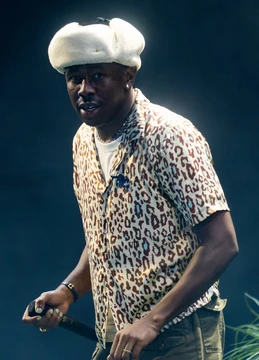
Pharrell Williams
The joyful architect who taught Tyler's world that softness is its own kind of strength.

Pharrell Williams is a Grammy-winning musician, producer, songwriter, and fashion architect whose influence stretches across hip-hop, R&B, and high fashion. In the Tyler the Creator universe, Pharrell occupies the role of a seasoned creative elder—a figure who bridges the gap between raw, confrontational expression and polished, joyful artistry. His presence in Tyler's orbit represents a moment where the GOODS family's energy meets a more globally recognized, genre-fluid sensibility. For fans of Tyler's discography, Pharrell's involvement marks a specific inflection point: a collaboration that injects warmth, melodic sophistication, and a sense of playful confidence into Tyler's evolving sound. He is less a mentor figure in the traditional sense and more a parallel creative force—someone who proves that vulnerability, humor, and technical mastery can coexist without diluting either.
- Role
- Producer, collaborator, and fashion designer within Tyler's creative ecosystem
- Affiliation
- N.E.R.D., Billionaire Boys Club, Human One, Louis Vuitton (menswear creative direction)
- First notable Tyler collaboration
- Flower Boy era (2017)
- Primary instruments/mediums
- Production, songwriting, vocal performance, fashion design
- Status
- Active artist, designer, and entrepreneur
Lore & Background
In the broader mythology of Tyler the Creator's creative universe, Pharrell Williams functions as a kind of creative north star—someone who arrived at the intersection of music and fashion before the GOODS label even existed. His work with N.E.R.D. in the early 2000s established a template: music that is simultaneously experimental, accessible, and deeply personal. When Tyler was still building his world from the raw edges of Odd Future, Pharrell was already demonstrating that a rapper could also be a fashion visionary, a pop songwriter, and a cultural tastemaker without losing credibility. The Flower Boy era represents the moment these two creative philosophies collided. Tyler, who had spent years building an identity around aggression, dark humor, and self-deprecation, was navigating a period of genuine emotional openness. Pharrell's production brought a specific quality to that album: a sense of lightness, of melodic generosity, of a world where the music could simply be fun without being careless. It was the sound of someone who had already figured out that joy and pain are not opposites but collaborators. The clothing, the album art, the live show, the music: all one statement. Pharrell proved that model at a global scale, and Tyler's own evolution toward more polished, fashion-forward presentations can be read as part of a broader cultural conversation that Pharrell helped start.
In Their Own Story
The studio is bathed in that particular amber light that only exists at 2 a.m. in a converted warehouse. Tyler is on the couch, hoodie pulled up, scrolling through phone photos of a jacket he wants to rework. Pharrell is at the mixing desk, headphones around his neck, turning a knob with the casual precision of a chef adjusting salt. They've been working on a verse for three hours. Not the production—Tyler's production, the arrangement, the whole sonic architecture is already there. But the verse. The words. Pharrell keeps humming a counter-melody, not singing it, just letting it float in the air between them like a suggestion. Tyler finally looks up. "Yeah," he says. "That's the one." Pharrell doesn't smile. He just nods, turns back to the desk, and starts building the bridge. Outside, the city hums its low electric hum. Inside, two guys who both learned to make noise before they learned to make peace are making something that sounds like both.
Reader's Guide
Pharrell Williams enters Tyler's world not as a mentor or a gatekeeper but as a parallel creative force—a fellow traveler who arrived at the same destination (music that is unapologetically personal, joyful, and technically rigorous) by a different road. Where Tyler's early work was built on confrontation, dark comedy, and a refusal to be comfortable, Pharrell's body of work carries a different emotional register: warmth, melodic generosity, a sense that the music is an invitation rather than a challenge. Their intersection on Flower Boy (2017) is the clearest point of contact, where Pharrell's production adds a layer of lightness and melodic sophistication to an album already steeped in vulnerability. What makes Pharrell distinctive in Tyler's narrative is his role as proof-of-concept. He demonstrated, years before Tyler's own evolution, that a hip-hop artist could be a fashion icon, a pop songwriter, and a serious producer simultaneously without any of those identities canceling the others out. Tyler's own trajectory toward more polished, fashion-forward, emotionally open work can be read as part of the same cultural conversation Pharrell helped open. In the GOODS family dynamic, Pharrell is the outside voice that validates the inside. He doesn't need to explain himself to the Tyler universe; the Tyler universe, in turn, recognizes in him a kindred spirit who simply took a slightly different path through the same forest. His contribution is not a single track or a single jacket but a whole philosophy: that playfulness is a form of mastery, and that the most radical thing a creator can do is be genuinely, unguardedly happy.
Did You Know?
- Pharrell co-founded both Billionaire Boys Club and Human One, two fashion labels that treated streetwear and high fashion as the same conversation rather than opposing camps.
- His production and songwriting work spans decades and genres—from N.E.R.D.'s experimental hip-hop to the globally recognized pop single 'Happy' from Despicable Me—making him one of the most genre-fluid figures in modern
- Pharrell's tenure as creative director for Louis Vuitton menswear made him the first Black American to hold that position, reshaping how luxury fashion engages with street culture.
- His collaborative philosophy—building projects around small, tight-knit creative circles rather than large corporate teams—mirrors the GOODS label model that Tyler built from the ground up.
Frequently Asked Questions
How did Pharrell Williams first connect with Tyler the Creator?
Pharrell first became a notable collaborator during the Flower Boy era in 2017, stepping into Tyler's creative circle as a producer and vocal contributor. His involvement marked a shift where Tyler's confrontational sound began blending with a warmer, more globally aware sensibility.
What did Pharrell Williams actually contribute to Flower Boy?
On Flower Boy, Pharrell brought production, songwriting, and vocal performance that helped steer the album toward a softer, more melodic direction. His touch added a polished, genre-fluid quality that sat alongside Tyler's own lyricism without overpowering it.
Is Pharrell Williams officially part of the GOODS family?
Pharrell is not a formal member of the GOODS collective, but his creative orbit overlaps with Tyler's through shared energy and mutual respect. He functions more as a seasoned collaborator who bridges Tyler's world with broader hip-hop, R&B, and fashion spaces.
What is Pharrell Williams known for outside of Tyler the Creator?
Beyond his Tyler collaborations, Pharrell is a Grammy-winning producer, the founding voice of N.E.R.D., a co-founder of Billionaire Boys Club, and a fashion designer who has held creative-direction roles at Louis Vuitton. His career spans production, songwriting, vocal performance, and high-fashion design.
Why do Tyler fans see Pharrell Williams as a turning point in his career?
Fans view Pharrell's involvement as the moment Tyler's raw, confrontational identity gave way to a more joyful and vulnerable artistic phase. His presence signaled that softness and global polish could coexist with Tyler's signature energy, redefining what the GOODS family's sound could become.
More in Collaborators & People
Elsewhere in the Tyler the Creator universe
Spotted an error? Know more?
This is a living reference — every entry is fact-audited, and reader corrections feed straight into our audit queue. Suggest an edit · See this site's audit record