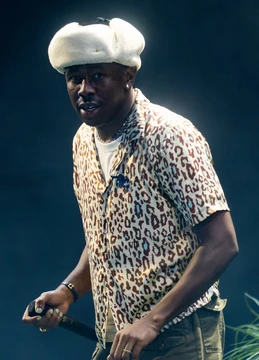
Flower Boy (2017)
A pastel-colored confession that redefined what a rap album could feel.

Flower Boy is Tyler the Creator's fourth studio album, released in 2017, and is widely regarded as the definitive turning point in his artistic career. Where his earlier records were built on aggression, dark humor, and confrontational energy, Flower Boy opens the door to tenderness, self-doubt, and a quiet, almost fragile confidence. The album functions as an emotional autobiography: a young artist publicly processing his sexuality, his mental health, and his desire to be soft in a world that had rewarded him for being hard. Culturally, Flower Boy did more than chart. It introduced a full sensory identity—the pastel palette of pink, lavender, and mint green; the tailored suits; the garden-and-golden-hour visual language—that bled into fashion, music-video grammar, and the broader hip-hop aesthetic for years afterward. For fans, it is the album where Tyler stopped performing a character and started inhabiting himself.
- Studio album number
- 4th
- Label
- Odd Future Records
Lore & Background
In the mythology of Tyler's discography, Flower Boy occupies the space between the wolf and the garden. The earlier albums—Goblin, Wolf—were built on a thesis of controlled chaos: a young man who weaponized his pain into spectacle. Flower Boy dismantles that architecture. The narrative arc of the record moves from the guarded, slightly performative confidence of the opening tracks into a rawer, more exposed middle section where Tyler speaks directly about desire, loneliness, and the fear of being seen without armor. By the closer, the tone settles into something almost liturgical: a quiet declaration that softness is not the absence of strength. The album's world is one of late-afternoon light, silk shirts, and rooms that smell like eucalyptus. The production leans into warm, rounded tones—soft-snap hi-hats, lush string pads, a vocal delivery that often slips into half-sung melodic phrasing. The collaborators are chosen not for shock value but for emotional resonance: a singer who can hold a note like a held breath, a rapper who brings a cold, detached edge that contrasts Tyler's warmth, a producer whose beats feel like they were recorded in a sunlit studio rather than a basement. For the fan community, Flower Boy became a shared emotional vocabulary. The term 'flower boy' entered everyday language, and the pastel aesthetic became a shorthand for a particular kind of vulnerability in hip-hop culture. The album is less a collection of singles than a sustained, hour-long act of self-forgiveness, and its power lies in the fact that it asks the listener to sit in that forgiveness without looking away.
In Their Own Story
The party is over, but the lights haven't been turned off yet. Tyler stands in the kitchen of a rented house in the hills, a glass of something amber in one hand, the other resting on the counter where a single lavender stem has been stuck in a shot glass. The bass from the living room is muffled now, just a low hum in the floorboards. He's wearing the pink suit, the one that made the internet lose its mind, and the fabric is warm against his neck in a way that feels almost like a hand. Outside, the sky is doing that thing where it can't decide between gold and violet, and the garden is going soft and indistinct in the fading light. He hums something—no melody, just a shape, a contour. The glass fogs in his fingers. He doesn't turn the lights on. He doesn't need to. The room is already the color he wants it to be.
Reader's Guide
Flower Boy arrives after years of Tyler building a reputation on shock, aggression, and dark humor. The creative context is one of personal reckoning: he had been working on material for a long stretch, and the record that emerged was shaped by his evolving relationship with his own identity, his sexuality, and his desire to stop performing a persona. The album's thesis is simple and radical for its space in hip-hop: you are allowed to be soft, to want tenderness, to grieve without an audience. The production is a key part of the shift. Tyler's own beats lean into warmth—rounded percussion, layered vocal textures, strings that swell like a held breath. The featured artists are chosen for emotional compatibility rather than crossover appeal, creating a record that feels like a conversation among people who trust each other. Tracks that became touchstones for fans include the Frank Ocean collaboration, the Sampha duet, and the SZA feature, each one a different shade of the same emotional argument. Reception was overwhelmingly positive, with critics noting the album's courage and its expansion of what mainstream hip-hop could express. Commercially it was a strong showing, and the pastel visual identity—tailored suits, garden settings, golden-hour lighting—became a cultural touchstone that influenced fashion and music-video aesthetics well beyond the album's release window. For Tyler's trajectory, Flower Boy is the hinge. After it, the vulnerability is not a phase or a surprise; it is the baseline. The later work builds on the permission the album grants: that the artist can be funny and tender in the same breath, that the garden and the wolf are not opposites but neighbors.
Did You Know?
- The album reportedly took several years to complete, with Tyler going through significant personal and emotional changes during its creation that reshaped its direction.
- The pastel color palette introduced with Flower Boy became so strongly associated with Tyler that it influenced broader hip-hop fashion and music-video aesthetics for years afterward.
- The album's featured roster spans multiple genres and eras of hip-hop, creating a record that feels less like a guest list and more like a roundtable of trusted voices.
- The term 'flower boy' entered common cultural usage after the album, becoming a shorthand for a particular kind of vulnerable, self-possessed masculinity in popular discourse.
More in Albums & Discography
Elsewhere in the Tyler the Creator universe
Spotted an error? Know more?
This is a living reference — every entry is fact-audited, and reader corrections feed straight into our audit queue. Suggest an edit · See this site's audit record