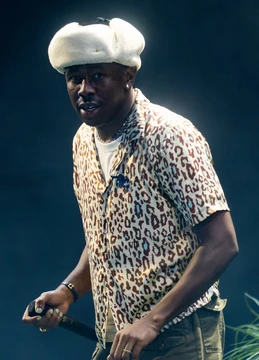
Bitch
A snarling, two-minute declaration that Tyler had nothing to prove and everything to say.

"Bitch" is a track by Tyler, the Creator that sits squarely within his raw, confrontational early period. It channels the unfiltered aggression and dark humor that defined his first solo releases, functioning as a sonic declaration of the persona he was building before the world got to know the softer, more melodic artist he would later become. The song is a compact burst of intensity—minimal in its arrangement but maximal in its attitude—that fans of that era still point to as a defining moment of Tyler's pre-transformation identity.
Within the broader Tyler universe, tracks like this one represent the foundation: the shock, the provocation, the refusal to be palatable. They are the counterweight that makes his later, more tender work feel earned rather than merely a shift in tone. Listeners who grew up with Odd Future and the early solo records often cite songs in this vein as the sound that first made them pay attention.
- Artist
- Tyler, the Creator
- Era
- Goblin period (2011)
- Role
- Album track
- Genre
- Hip-hop / experimental
- Production
- Tyler, the Creator (self-produced)
- Affiliation
- Odd Future / OFWGKTA era
Lore & Background
The track lives in the world Tyler was constructing around 2011: a landscape of dark comedy, confrontational wordplay, and production that felt deliberately rough-edged, almost lo-fi in its aggression. At a time when his public image was still wrapped in shock value and internet provocation, songs like this one served as both artistic statement and armor. The beat is sparse, the vocal delivery is close-mic'd and unhinged, and the overall effect is that of someone talking directly into a microphone in a small room with zero filter.
For the Odd Future community and the wider hip-hop audience discovering Tyler online, this era of his catalog represented a specific cultural moment: a young artist using transgression as a creative tool, pushing past the boundaries of what mainstream rap allowed. The track's title and delivery were designed to be memorable, to be shared, to be argued about. It was less a song to sit back and enjoy and more a song to react to, to screenshot a lyric from, to play at a party and watch people flinch.
In the Tyler universe, this period is the 'before'—the necessary darkness that makes the color of Flower Boy and the warmth of Call Me If You Get Lost feel like a genuine evolution rather than a rebrand. Fans who respect the full arc tend to treat tracks from this era with a kind of affectionate respect, acknowledging the rawness without necessarily endorsing every choice.
In Their Own Story
The studio is a basement in Long Beach, the air thick with cigarette smoke and the hum of a single amplifier. Tyler sits cross-legged on a mattress, headphones around his neck, talking into a mic that's probably a generation or two out of date. He's not performing. He's not even really rapping. He's just talking, snarling, laughing, and the engineer hits record because the moment is already happening. The beat underneath is a loop he made that morning—two kicks, a snare, a bass note that rattles the cheap walls. He does it once. He does it again, louder, angrier, more himself. The tape rolls. Somewhere upstairs, a neighbor bangs on the ceiling. Nobody stops.
Reader's Guide
The production on this track is deliberately stripped back: a two-bar loop, a bass that hits in the chest, and Tyler's voice up close enough to hear the breath between syllables. There's no polish, no layered ad-libs, no melodic hook to soften the edges. The choice to keep it this bare is the point. In 2011, Tyler was building a reputation on the idea that he was untouchable, unrefined, and unapologetic, and the track's sonic minimalism mirrors that. Every element that isn't there is a statement.
The vocal moment that made it stick is the delivery itself—Tyler talking over the beat with a cadence that shifts between mocking, aggressive, and almost tender, all within a few bars. It's not a performance in the traditional sense; it's closer to a confession delivered at a party where nobody asked. The cultural moment it landed in was one of Tyler going from a viral internet figure to a recognized artist, and tracks like this were the bridge. They told the audience: this is who I am, and I'm not going to explain myself.
What it shaped in the public's mind was the expectation of contrast. Because Tyler committed so fully to this aggressive, confrontational identity, every subsequent softening felt like a real choice rather than a default. Fans who heard this era first tend to listen to his later work with an awareness of how far the sound traveled, and that awareness is part of what makes the later records resonate so deeply.
Did You Know?
- Tracks from this period of Tyler's catalog were often produced with minimal equipment in small, informal spaces, contributing to the raw, close-mic'd sound that became a hallmark of his early releases.
- The confrontational tone of this era was partly a reaction to the online harassment and misrepresentation Tyler faced as a teenager, turning public ridicule back on itself as creative material.
- Tyler's early solo work and the Odd Future collective's music were distributed heavily through file-sharing and early streaming platforms before traditional label deals solidified, meaning tracks like this reached audien
- The shift from this aggressive, shock-driven sound to the melodic, emotionally open production of his mid-to-late career is one of the most discussed arcs in modern hip-hop, with fans often tracing the exact tracks where
More in Signature Tracks & Sounds
Elsewhere in the Tyler the Creator universe
Spotted an error? Know more?
This is a living reference — every entry is fact-audited, and reader corrections feed straight into our audit queue. Suggest an edit · See this site's audit record