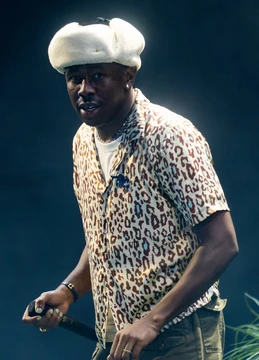
Flower Boy
The goblin shed his armor, put on a flower crown, and let the world see him cry.

Flower Boy is the fourth studio album by Tyler the Creator, released in September 2017. It marked a seismic creative pivot for the artist, shedding the aggressive, confrontational persona of his earlier work in favor of a tender, openly vulnerable exploration of queerness, self-acceptance, and emotional honesty. The album's pastel-and-bloom aesthetic became a cultural touchstone, signaling a new era in Tyler's public identity.
Within Tyler's broader artistic arc, Flower Boy occupies the pivotal middle chapter: the album where the 'Goblin' fully bloomed into the person behind the mask. It bridges the raw, unfiltered chaos of the Odd Future years with the polished, genre-fluid maximalism of the later Chromakopia period, serving as the emotional and thematic foundation everything after it builds upon.
- Artist
- Tyler the Creator
- Studio album number
- 4th
- Release year
- 2017
- Notable featured artists
- Kendrick Lamar, Playboi Carti, Frank Ocean
- Thematic core
- Queer self-acceptance, vulnerability, emotional openness
- Aesthetic era
- Flower Boy (pastel, floral, soft)
- Significance
- First album to openly center Tyler's queer identity and emotional fragility
Lore & Background
In the Tyler the Creator universe, Flower Boy is less an album than a coming-out story told in 16 tracks. After years of building a brand around shock, aggression, and the 'Goblin' alter-ego, Tyler chose to dismantle that architecture piece by piece. The album's visual language—pale florals, soft fabrics, a man in a garden—became a deliberate, almost ritualistic rejection of the leather, the spikes, the hostility that defined the earlier Odd Future years. Fans who had followed since Bastard or Goblin recognized the shift not as abandonment but as evolution: the same restless, self-obsessed creative energy, now pointed inward instead of outward.
The narrative throughline of the record moves from guarded self-doubt to a hard-won, fragile peace. Tracks about loneliness, about the terror of being seen, about the specific grief of a queer man navigating a world that never built space for him—these sit alongside bouncy, almost playful production that refuses to let the album become a eulogy. The result is a record that sounds like someone rehearsing a confession in a mirror, then deciding to say it out loud, then deciding it's okay to laugh about it afterward. That tonal whiplash—tenderness braided with humor, pain braided with bounce—became the signature of the Flower Boy era and carried forward into everything that followed.
For the fan community, the album's cultural weight extends beyond the music. The 'Flower Boy' aesthetic became a shared visual language: flower crowns, pastel layers, the softness of a man who no longer needed to be the loudest voice in the room. It gave a generation of listeners who felt similarly excluded a vocabulary for softness that wasn't weakness, and that resonance is why the album still functions as a touchstone years after its release.
In Their Own Story
The studio was quiet in that particular way it gets at 2 a.m., when the city outside has gone soft and the only sound is the hum of the console. Tyler sat cross-legged on the couch, a half-eaten plate of something sweet forgotten beside him, staring at a lyric he'd rewritten four times. The word 'boy' kept appearing in the lines, and every time he typed it, his chest did that tight, hot thing. He deleted it. Typed it back. Deleted it again.
Then he stopped fighting it. He let the word sit there, let the whole sentence breathe, and for the first time the line didn't sound like a performance. It sounded like a Tuesday. Like a kid in a garden, dirt under his nails, saying the thing he'd been circling for years. He hit record, sang it once, badly, and the take was the one that stayed. Outside, the first pale light of morning crept under the door, and the flowers on the windowsill—bought on a whim, already wilting—looked, for a moment, like they were listening.
Reader's Guide
Flower Boy lands in 2017 as the emotional midpoint of Tyler's career. After the abrasive, confrontational energy of the Odd Future years and the raw, almost unpolished chaos of Wolf, Tyler enters the studio with a clear intention: to be seen. The creative context is one of exhaustion with performance—years of being the loudest, angriest voice in the room, and the slow realization that the mask was becoming the face.
The thematic throughline is self-acceptance as an ongoing, imperfect process. Tracks circle around queer identity, loneliness, the fear of softness, and the specific grief of a man who spent his teens building armor. The production leans melodic and warm, with Tyler handling much of the beats himself, layering soft synths and lo-fi textures over hip-hop rhythms. Standout moments include a tender collaboration with Kendrick Lamar, a playful bounce with Playboi Carti, and a duet with Frank Ocean that crystallizes the album's central question: what does it cost to be gentle in a world that rewards hardness?
Critically and commercially, the album was a landmark. It debuted at the top of the Billboard 200 and was widely praised for its emotional honesty, marking the moment Tyler's vulnerability became his superpower rather than his weakness.
In the broader arc from the OF era to Chromakopia, Flower Boy is the hinge. It takes the raw, unfiltered self-obsession of Goblin and Wolf and channels it into something introspective and tender. Everything after—Chromakopia's maximalist genre-hopping, Call Me If You Get Lost's cinematic storytelling—builds on the emotional permission this album granted. Tyler learned to be soft here, and never fully stopped.
Did You Know?
- The 'Flower Boy' aesthetic—pastel florals, soft fabrics, a flower crown—was a deliberate, public rejection of the 'Goblin' persona Tyler had cultivated since 2011, and it became a shared visual language for a whole gener
- The album marked Tyler's first time openly and centrally exploring his queer identity in his music, a shift that fans and critics widely recognized as a genuine coming-out moment rather than a marketing choice.
- The collaboration with Kendrick Lamar on 'See You Again' was notable both for the chemistry between the two artists and for the track's role as an emotional anchor in the album's narrative arc.
- Flower Boy's soft, melodic production approach—Tyler handling much of the beat-making himself with warm synths and lo-fi textures—became a template for the genre-fluid sound that would define his later work through Chrom
More in Albums & Discography
Elsewhere in the Tyler the Creator universe
Spotted an error? Know more?
This is a living reference — every entry is fact-audited, and reader corrections feed straight into our audit queue. Suggest an edit · See this site's audit record