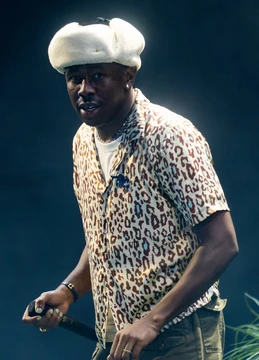
Camp Flog Gnaw
A family reunion with a sound system the size of a city block.

Camp Flog Gnaw is the self-produced music and culture festival created by Tyler the Creator, first staged in 2016 in Los Angeles. It operates as a living extension of the Odd Future community and the Golf Wang aesthetic, gathering hip-hop, electronic, R&B, and experimental artists under one roof in an environment Tyler has consistently framed as a family reunion rather than a commercial product. In the wider Tyler-the-Creator mythology, the festival is where the fanbase becomes the audience, the audience becomes the community, and the community becomes the point.
Rather than following the corporate festival playbook—tiered VIP zones, sponsor-laden stages, alcohol-driven revenue—Camp Flog Gnaw has built its identity around curation, safety, and a distinctly West Coast, inclusive energy. It is the physical space where the narrative fans have been telling about Tyler since the early Odd Future days finally gets a stage, a sound system, and a weekend to breathe.
- Creator
- Tyler the Creator
- Category
- Music & culture festival
- First held
- 2016
- Primary city
- Los Angeles, California
- Affiliation
- Odd Future / Golf Wang ecosystem
- Status
- Ongoing annual event
- Defining tone
- Community-focused, family-oriented, genre-blended
Lore & Background
In the mythology fans build around Tyler the Creator, Camp Flog Gnaw is the moment the scattered pieces of the Odd Future story—the zines, the mixtapes, the fashion drops, the late-night studio sessions—finally get a shared address. The name itself carries the rough, playful energy of the early OF era: a slightly absurd compound that sounds like something a teenager would scribble on a notebook margin, yet it anchors an entire weekend of music, art, and community. Fans treat the festival less as a concert and more as a homecoming, the one weekend a year when the internet arguments and the group-chat drama dissolve into a single crowd moving to the same bass line.
Tyler has spoken in interviews about wanting the event to feel like a family gathering, where the emphasis is on showing up, being safe, and letting the music do the talking. That philosophy shapes every visible detail: the curation of lineups that cross genre lines without forcing them, the deliberate absence of the usual festival excess, the way the space is designed so that a teenager in a Golf Wang hoodie and a parent in a flannel shirt can stand in the same front row without either feeling out of place. The festival is, in narrative terms, the world Tyler built in his music made tangible—imperfect, loud, a little chaotic, but fundamentally welcoming.
Over successive editions, Camp Flog Gnaw has grown from a single-venue LA show into a multi-day, multi-stage experience that still carries the intimacy of its origins. Fans track its evolution the way they track Tyler's discography: each year adds a new layer, a new artist, a new visual identity, but the core promise stays the same. It is the Tyler universe with the lights turned up and the doors thrown open.
In Their Own Story
The gate opens at four and the parking lot is already a small city of its own—sunset-striped Golf Wang tees, a kid balancing a skateboard on one hand and a water bottle in the other, the low thrum of the soundcheck bleeding through the chain-link fence. Tyler appears at the back of the crowd, not on stage, just standing there in a hoodie with the sleeves pushed up, watching the first wave of people pour in like a slow tide. Someone calls his name. He nods, almost embarrassed, the way you'd nod at a cousin who's being too loud at Thanksgiving. By the time the headliner's first beat drops, the whole block is swaying in the same lazy, unselfconscious rhythm, and for one long golden evening the only thing that matters is the next bar, the next set, the next person's hand raised in the air. The sun goes down behind the hills. The lights come up. Nobody leaves early.
Reader's Guide
Camp Flog Gnaw sits at the intersection of two conversations Tyler has been driving since the mid-2010s: what hip-hop's community infrastructure can look like when the artist builds it himself, and what a fashion-forward, genre-fluid aesthetic does when it gets a physical address.
In hip-hop culture, the festival has become shorthand for Tyler's maturation—from the deliberately confrontational Odd Future of the early 2010s to a creator who wants to build spaces rather than just occupy them. Fans read the curation choices, the inclusive tone, the rejection of the usual festival economics as a narrative arc: the kid who made mixtapes in a garage is now the one deciding who gets a stage and what the vibe feels like. It echoes a broader shift in the genre where artists are becoming label heads, creative directors, and community builders simultaneously.
In the fashion and design world, the festival doubles as a runway for Golf Wang and the wider Tyler aesthetic. The staging, the color palettes, the way the crowd dresses—it all feeds back into the brand. Fans treat each edition's visual identity the way they treat an album cover: a snapshot of where the mythology is heading.
The wider story fans tell is one of ownership. In an industry where festivals are often corporate products with artist lineups bolted on, Camp Flog Gnaw is the inverse: the artist is the product, the community is the product, and the music is the reason they're all in the same room.
Did You Know?
- Tyler has repeatedly described the festival in family and reunion language, framing it as a gathering of community rather than a ticketed commodity, a framing that has become central to how fans discuss its identity.
- The festival's curation deliberately spans hip-hop, electronic, R&B, and experimental acts, reflecting Tyler's own genre-fluid taste and the eclectic nature of the Odd Future community he grew up in.
- Camp Flog Gnaw is closely tied to the Golf Wang fashion brand and the broader Tyler creative ecosystem, meaning the visual identity of each edition often doubles as a soft launch for new design directions.
- The event has been a touchstone in fan discussions about what a hip-hop-adjacent festival can look like when it prioritizes safety, inclusivity, and community over the typical corporate festival model.
More in Lore & History
Elsewhere in the Tyler the Creator universe
Spotted an error? Know more?
This is a living reference — every entry is fact-audited, and reader corrections feed straight into our audit queue. Suggest an edit · See this site's audit record