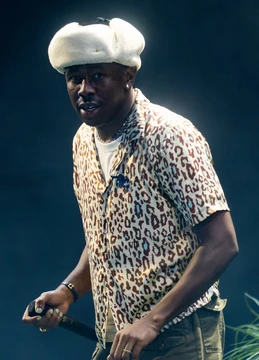
Golf Wang
A nine-iron in hand, a green crown on the head—power without the trigger.

Golf Wang is the fashion label and cultural identity that grew out of Tyler, the Creator's music career, evolving from small-batch merchandise into a recognized streetwear brand. At its core sits a single, deliberately chosen symbol: the golf club. Where hip-hop culture had long used the firearm as shorthand for power and survival, Tyler swapped in a nine-iron, reframing dominance as something you swing at a ball rather than at a person. That one image became the spine of an entire brand, a visual language, and a personal manifesto.
Golf Wang is not merely a clothing line; it is the sartorial arm of Tyler's broader creative universe. It carries the same irreverent humor, the same confrontational tenderness, and the same insistence on self-definition that define his music. Fans and collaborators alike treat the brand as an extension of the artist himself—his palette, his jokes, his evolution from a controversial young provocateur into a design-forward cultural figure.
- Brand
- Golf Wang
- Founder
- Tyler, the Creator (Tyler Okonma)
- Type
- Fashion / Streetwear label
- Core Symbol
- Golf club
- Origin context
- Tied to the Odd Future collective and Tyler's early merch efforts
- Status
- Active
- Well-known collaborations
- Nike, Converse
Lore & Background
The golf club in Tyler's world is never just a sporting implement. It is a loaded (pun intended) signifier: a weapon that doesn't kill, a status object that doesn't threaten, a tool of precision rather than destruction. By centering the brand on this image, Golf Wang quietly rewrites a long-standing visual code in hip-hop. The green of the fairway, the white of the ball, the metallic sheen of the club head—these become a palette and a grammar that fans recognize instantly, even without a logo.
The brand's trajectory mirrors Tyler's own. Early Golf Wang pieces were scrappy, hand-stamped, sold at shows and through small online drops, often featuring the club icon alongside bold, sometimes confrontational typography. As Tyler's music matured and his public persona softened, the label followed: silhouettes grew more refined, collaborations with heritage brands like Nike and Converse brought the Golf Wang mark into mainstream retail, and the aesthetic broadened while keeping its signature green-and-white identity intact. The shift from underground zine energy to polished runway-adjacent drops is, for many fans, a visible record of Tyler growing up in public.
Within the wider Odd Future ecosystem, Golf Wang served as the collective's visual anchor when the group was still a loose, chaotic crew. It gave a shared aesthetic to a community that otherwise expressed itself through shock, humor, and raw musical energy. Even as Odd Future's collective output faded, Golf Wang persisted as a personal through-line, a constant in a career that has pivoted across albums, films, and fashion collections.
In Their Own Story
The studio is dark except for the amber glow of a single lamp. A golf club leans against the mixing console, its head catching the light like a small, quiet blade. Tyler sits cross-legged on the carpet, a half-finished hoodie spread across his knees, the fabric the exact shade of a late-summer fairway. He traces the club's grip with one thumb, thinking about the word *wang* the way you'd think about a name that's almost a word, almost a sound, almost a feeling. Outside, the city hums its low, indifferent hum. He pins a small iron-shaped button to the hoodie's chest, steps back, squints. Good. It says what he needs it to say: I'm here, I'm sharp, I'm not pointing at you. He folds the garment, slides it into a poly bag, and whispers a price that's too low, because it's always too low, because the point was never the point. The lamp flickers. The club stays where it is. The brand breathes.
Reader's Guide
Golf Wang lives at the intersection of hip-hop iconography and fashion design, and understanding it means understanding the symbols Tyler chose and the conversations he entered.
The golf club is the linchpin. In a genre where the gun had become almost a logo, Tyler's substitution was a small, radical act of re-signification. Fans read it as disarming, as choosing a sport over a shooting, as a young Black man saying *my power looks like a swing, not a trigger*. That single image carried the brand's entire visual identity for years.
The color palette—greens, whites, occasional golds—echoes the fairway and the ball, but it also reads as a deliberate break from the black-and-white or red-and-black palettes that dominated streetwear. It felt pastoral, almost pastoral, in a genre that had long coded itself as urban and confrontational. That tension is where much of the brand's charm lives.
In the wider fashion conversation, Golf Wang sat alongside labels like Supreme, Stüssy, and later Off-White as part of the streetwear-to-luxury pipeline. Its collaborations with Nike and Converse gave it shelf space in stores that had previously belonged to established sportswear houses, while its independent drops kept a cult, drop-culture energy. For many in the Tyler orbit, wearing a Golf Wang piece was less about the garment and more about signaling membership in a particular emotional community—one that valued humor, vulnerability, and the right to be weirdly, specifically yourself.
Did You Know?
- The golf club was a deliberate visual replacement for the firearm, a symbol Tyler has used across music videos, album art, and merchandise to reframe the hip-hop power narrative.
- Golf Wang began as small-batch, show-day merchandise closely tied to Odd Future's early live shows before growing into a standalone label with its own drop calendar.
- The brand's green-and-white palette, drawn from the fairway and the ball, became a recognizable visual signature that set it apart from the darker palettes common in streetwear at the time.
- Golf Wang's collaborations with major sportswear brands like Nike and Converse helped bridge the gap between underground hip-hop merch culture and mainstream retail fashion.
More in Lore & History
Elsewhere in the Tyler the Creator universe
Spotted an error? Know more?
This is a living reference — every entry is fact-audited, and reader corrections feed straight into our audit queue. Suggest an edit · See this site's audit record