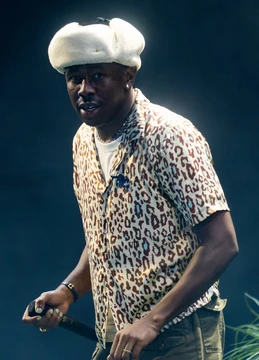
Odd Future
A pack of Los Angeles wolves who turned shock, self-made grit, and community into a cultural dynasty.

Odd Future (OFWGKTA) is the Los Angeles-based creative collective, record label, and cultural movement founded by Tyler, the Creator as a teenager in the late 2000s. What began as a shock-laden website and a loose group of friends making raw, confrontational music grew into one of the most influential independent forces in modern hip-hop, fashion, and internet culture.
The collective's identity is built on the 'Wolf Gang' mythology: a pack of misfit, aggressive, self-made creators who rejected industry gatekeeping and built an entire ecosystem—music, clothing, video, community—on their own terms. For fans, Odd Future represents the story of a group of kids from the West Coast who turned internet notoriety, dark humor, and relentless DIY energy into a lasting cultural institution.
- Full name
- OFWGKTA (Odd Future, Wolf Gang Kill Them All)
- Founded by
- Tyler, the Creator
- Founded
- Late 2000s
- Base
- Los Angeles, California
- Type
- Music collective / independent record label
- Notable members
- Tyler, the Creator, Earl Sweatshirt, Hodgy Beats, YG
- Status
- Active (label and collective)
Lore & Background
The story of Odd Future begins in the world of a teenage Tyler Okonkwo in Los Angeles, who, alongside friends Earl Sweatshirt, Hodgy Beats, and others, created a website that became infamous for its unfiltered, provocative content—gore, dark comedy, and a general 'anything goes' energy that made it a target of both fascination and outrage. The site was less a business plan and more a declaration: these kids were going to make noise, and no one was going to tell them how. The acronym OFWGKTA, with its deliberately aggressive 'Kill Them All' tag, was part joke, part manifesto, part brand identity forged in the crucible of early-2000s internet culture.
As the collective's music matured, the shock value gave way to something more layered. The early mixtapes were chaotic, confrontational, and undeniably raw, but the group's songwriting showed a depth that surprised critics who had dismissed them as attention-seekers. The 'Wolf Gang' aesthetic—hoodies, wolf imagery, a palette of black, white, and muted earth tones—became a visual language that fans recognized instantly. Tyler's fashion label, Golf Wang, grew out of the collective's need to dress themselves and their community, eventually becoming a major player in streetwear and a bridge between hip-hop and high fashion.
The collective's narrative arc is one of redemption and reinvention. The early years were defined by controversy, arrests, and a public image that was often reductive. But over the following decade, the members individually and collectively evolved, with Tyler in particular becoming one of hip-hop's most critically celebrated artists. Odd Future as a label became a home for a generation of West Coast artists, and the 'pack' mythology—loyalty, self-sufficiency, creative independence—remains the emotional core of what fans love about the project. It is the story of kids who were told they were too much, too dark, too weird, and who answered by building an empire on their own terms.
In Their Own Story
The garage smelled like cheap incense and warm speaker cones. Tyler sat cross-legged on a concrete floor surrounded by a tangle of cables, a half-eaten burrito, and a laptop displaying the OFWGKTA site—its pages a collage of jagged typography, wolf silhouettes, and images that would make a school principal call the police. Earl was on the phone, laughing, saying something about 'making it sound like a car crash on purpose.' Hodgy was sketching a new hoodie design on the back of a utility bill. Outside, the Los Angeles sun was bleeding orange over the hills, and none of them were twenty yet. They didn't have a manager, a contract, or a plan beyond the next track, the next upload, the next time someone would screenshot their site and share it in a forum. They just had each other, a shared conviction that the world was going to look at what they made and either be impressed or be mad—and both outcomes were the same victory. The speakers crackled. They hit record. The pack was hunting.
Reader's Guide
Odd Future occupies a unique space in hip-hop mythology: it is the story of a collective that was *too much* for its time and then outgrew the very excess that defined it. Fans tell the story in chapters—the 'shock era' of the website, the raw mixtape years, the post-2012 reckoning, and the slow, deliberate building of a label and fashion house that could stand on its own.
The wolf is the central totem. It is not the polished, corporate wolf of a sports team logo. It is the scrappy, snarling, slightly feral wolf of a kid who learned to beatbox in a bedroom and sell hoodies from a garage. The aesthetic—black and white, utilitarian, slightly military, always a little aggressive—became a visual shorthand that fans could identify across a crowd. Golf Wang turned that aesthetic into a language that bridged underground hip-hop and the runways of Paris and Milan.
Culturally, Odd Future's story feeds into a larger conversation about who gets to be a 'brand' in hip-hop. These were not executives. They were teenagers with a website and a grudge. The narrative fans love is the DIY one: no label advance, no A&R, no permission. Just a pack of wolves who decided the forest was theirs. In the wider fashion and music world, that story became a template for a generation of artists who built empires outside the traditional machinery.
The mythology also carries the weight of Tyler's personal arc—from the 2012 incident that made headlines worldwide to the later, more introspective and vulnerable work. Fans read Odd Future's evolution as a mirror for his own: from the boy who needed the world to be shocked, to the man who could simply be honest. The pack, in that reading, grew up with him.
Did You Know?
- The OFWGKTA acronym—'Odd Future, Wolf Gang Kill Them All'—was deliberately provocative and has been a source of both branding power and public controversy throughout the collective's history.
- Tyler, the Creator was a teenager when he founded the collective, and the early website and mixtapes were created largely by a small group of friends in Los Angeles without any traditional industry backing.
- The collective's fashion line, Golf Wang, grew out of the group's need to create their own visual identity and eventually became a significant force in streetwear and high fashion, bridging hip-hop culture with the broad
- The 'Wolf Gang' identity and its associated imagery—wolves, pack loyalty, self-made aggression—served as a unifying mythology that bound the members and their fan community together across music, fashion, and online cult
More in Lore & History
Elsewhere in the Tyler the Creator universe
Spotted an error? Know more?
This is a living reference — every entry is fact-audited, and reader corrections feed straight into our audit queue. Suggest an edit · See this site's audit record