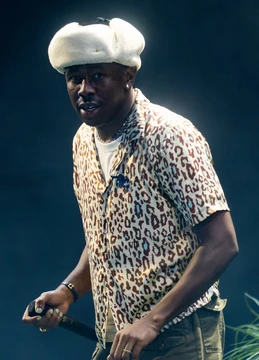
The Bitch Vocal
One shouted syllable that became the loudest fingerprint on a generation's hip-hop.

The Bitch Vocal is the signature exclamation ad-lib that Tyler the Creator has woven into his performances and recordings since the earliest days of Odd Future. It is not a single track but a recurring vocal gesture—a sharp, staccato 'Bitch!' shouted over beats, into microphones, or directly at crowds—that became one of the most instantly recognizable sonic fingerprints in modern hip-hop. Fans and critics alike use the phrase to describe a specific texture of Tyler's delivery: confrontational, rhythmic, and deliberately jarring against the melodic or lo-fi production surrounding it.
Its role in Tyler's artistry is twofold. Musically, it functions as a percussive vocal hit, punctuating bars and filling space the way a hi-hat or snare would. Culturally, it became shorthand for the unfiltered, aggressive persona Tyler cultivated in his mid-to-late-2000s and early-2010s work, a persona he has since consciously softened and recontextualized. Tracing the arc of that vocal—from a weapon in the hands of a teenager in Compton to a nostalgic, almost affectionate callback in later shows—tells the story of Tyler's entire artistic evolution.
- Artist
- Tyler the Creator
- Type
- Signature vocal ad-lib / production element
- Primary era
- Mid-2000s through early 2010s (Odd Future period)
- Collective
- Odd Future
- Function
- Percussive vocal punctuation, crowd engagement, identity marker
- Evolution
- Shifted from aggressive confrontation to playful or absent usage in later catalog
Lore & Background
The vocal sits at the intersection of Tyler's personal history and the broader Odd Future aesthetic. In the collective's early life—skateboarding in the hills of Compton, recording in cramped rooms, performing at tiny shows—the 'Bitch!' was less a lyric and more a reflex, a way to command a room full of peers who might otherwise tune out. It carried the energy of a kid who had been told he did not belong, turning rejection into a rhythmic weapon. Over time, it bled into recordings, appearing as a breathless interjection between bars, a call-and-response prompt for the audience, and a structural beat element that producers would time to the kick drum.
As Tyler's sound matured through the mid-2010s and into the Flower Boy and Igor era, the vocal did not vanish so much as change temperature. Where it once landed like a slap, it later appeared with a smirk, a half-laugh, or a wry tilt of the head. Fans noticed the shift and debated it in online communities: some mourned the loss of raw aggression, others celebrated the growth. The vocal became a touchstone for comparing eras, a small sonic artifact that let listeners measure how far the artist had traveled.
In live settings, the element retains a ritualistic quality. Even when a set is melodic and gentle, the moment Tyler catches the mic and lets out that sharp, clipped exclamation, the room's energy shifts. It is a reset button, a reminder that the performer still holds the power to be loud, and the audience still has the freedom to be startled. That duality—tenderness and volume coexisting in one artist—is perhaps the vocal's deepest legacy.
In Their Own Story
The venue is a converted warehouse in the San Fernando Valley, the kind of space that smells like old concrete and cheap beer. The crowd is packed tight, mostly kids in oversized hoodies and skate shoes. Tyler is mid-set, the lights dimmed to a bruised purple, and the beat is soft—piano, a little reverb, his voice almost a whisper. Then, between two lines, he tilts the mic away, catches the eye of a kid in the front row who is recording on a phone, and lets it out. That single, clipped word. The kid flinches. The crowd roars. Tyler grins, shakes his head like he can't believe he did it, and goes right back to the gentle melody. The purple light catches the condensation on a water bottle, the bass thumps low in the chest, and for three seconds the whole room exists in that gap between aggression and tenderness. Then the beat swells, and no one can quite remember which version of him they were just listening to.
Reader's Guide
The Bitch Vocal is a Tyler signature because it compresses an entire artistic philosophy into a single syllable. Production-wise, it is almost never treated like a melodic element. It hits dry, close-mic'd, and slightly clipped, sitting in the same frequency band as a snare or a rim shot. In the early Odd Future recordings, you can hear it layered—sometimes doubled, sometimes pitched a half-step down—so it functions as rhythm as much as voice. The production choice to leave it unprocessed and raw is deliberate: it should sound like a person in the room, not a studio effect.
The lyrical moment that made it iconic is not a single bar but a pattern. Tyler would deliver a measured, almost conversational line, then break the cadence with the exclamation, resetting the listener's expectation. That disruption became a storytelling tool. In the cultural moment it landed—roughly 2009 to 2013—hip-hop was dominated by polished, autotuned delivery. Tyler's unpolished, almost feral vocal texture felt like a counter-programming. It signaled that the rapper was not performing a character but reacting in real time.
The vocal also shaped audience expectations. Fans who grew up with the early Odd Future shows came to anticipate the moment of volume, the sharp intake of breath before the shout. When Tyler later softened his delivery, the absence of that hit became its own statement. Listeners learned to read the silence as meaning. In every subsequent album, the question became: will he use it, and if so, what does that tell us about where he is now? That single question, repeated across a decade of releases, is the vocal's true legacy.
Did You Know?
- The ad-lib is often layered in production to function as a percussive hit, timed to the kick drum rather than the vocal melody, making it behave more like an instrument than a word.
- In early Odd Future live shows, the vocal was frequently used as a call-and-response prompt, with the crowd expected to echo it back, turning a one-syllable shout into a communal ritual.
- The element's prominence in Tyler's catalog serves as a useful barometer for fans tracking his artistic evolution: its frequency and tonal temperature shift noticeably between his early aggressive work and his later, mor
- Tyler's vocal style, including this ad-lib, drew comparisons to the raw, confrontational delivery of 1990s West Coast rap, yet its placement within lo-fi, sample-heavy production gave it a distinctly 2010s texture.
More in Signature Tracks & Sounds
Elsewhere in the Tyler the Creator universe
Spotted an error? Know more?
This is a living reference — every entry is fact-audited, and reader corrections feed straight into our audit queue. Suggest an edit · See this site's audit record