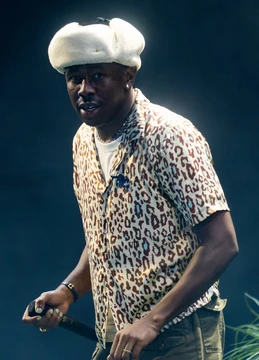
A$AP Mob
The fur-coated New York collective that turned a rap group into a fashion movement.

A$AP Mob is a New York City hip-hop collective that burst onto the scene in the late 2000s and quickly became one of the most visually arresting groups in modern rap. Defined by their signature fur coats, bold color palettes, and a shared commitment to treating music as a full aesthetic experience, the collective turned the idea of a 'rap group' into something closer to a fashion house with a sound system attached. In the wider Tyler the Creator ecosystem, A$AP Mob functions as the East Coast mirror to Odd Future: two collectives born in different cities, operating with different internal cultures, yet bound by a mutual belief that an artist's wardrobe, stage presence, and sonic identity should be inseparable.
Tyler's personal friendship and recurring collaborations with A$AP Rocky became the bridge between these two worlds. Where Odd Future carried the raw, chaotic energy of the West Coast, A$AP Mob brought a polished, almost cinematic swagger. Their intersection—on stages, in studio sessions, and in the broader hip-hop conversation—gave fans a living example of how two very different creative families could respect and elevate each other without losing their own identity.
- Type
- Hip-hop collective
- Origin
- New York City, USA
- Formed
- Late 2000s
- Notable members
- A$AP Rocky, A$AP Ferg, A$AP Yams, A$AP Nast, A$AP Ant, A$AP Bari
- Signature aesthetic
- Fur coats, saturated color blocking, 1980s-inspired styling
- Notable group release
- A$AP World (2012 mixtape)
- Tyler connection
- Recurring collaborator and close friend of A$AP Rocky; cross-collective performances and studio work
Lore & Background
A$AP Mob's story is inseparable from its look. In a hip-hop landscape where most groups leaned on baggy silhouettes or streetwear staples, this collective of Harlem-adjacent artists decided that a group identity could be built around color, texture, and theatricality. The now-iconic fur coat became their visual shorthand, but the broader palette—clashing neons, oversized silhouettes, accessories worn with total self-assurance—signaled that these artists were as invested in how they occupied a room as in what they said once the beat dropped. Their styling drew on 1980s and early-1990s hip-hop imagery while filtering it through a contemporary, almost editorial lens, and that blend gave a generation of fans a visual vocabulary for what a rap collective could be beyond a logo on a hoodie.
Musically, the group's output was intentionally varied. Rather than forcing a single sound, each member brought their own lane: A$AP Rocky's melodic, fashion-forward rapping; A$AP Ferg's braggadocious, beat-heavy delivery; A$AP Yams' more introspective, laid-back flows; A$AP Nast's gritty, street-level storytelling. The 2012 group mixtape A$AP World showcased that range and became a cultural touchstone, cementing the idea that a collective could function as a curated anthology rather than a monolithic act. The project also introduced the group's broader world to listeners who might not have encountered any single member before.
The collective's relationship with Tyler the Creator's orbit grew organically. Shared stages, studio sessions, and a mutual respect for each other's creative autonomy meant that A$AP Rocky and Tyler could move between Odd Future's chaotic, genre-bending energy and A$AP Mob's more structured, image-conscious world without either side feeling diluted. For fans, that cross-pollination felt like watching two rival fashion houses decide to do a joint runway show—chaotic, glamorous, and entirely unexpected.
In Their Own Story
The afterparty was still humming when Rocky slipped out the back of the venue, his fur coat catching the neon of the alley. Tyler was already waiting on the curb, a half-smoked cigarette between his fingers, laughing at something on his phone. "You're late," Tyler said, not looking up. "You're always late." Rocky grinned, the kind of easy, unbothered smile that made the whole night feel less like a performance and more like a Tuesday. They walked the block in silence for a while, the city's bass thumping through the soles of their shoes, and somewhere past the bodega with the flickering sign, Rocky said, "Let's go record something stupid." Tyler exhaled smoke through his nose. "Stupid is the only thing that's ever worked." They didn't plan a title. They didn't plan a release date. They just walked into the studio, let the beat find them, and made something that sounded like two cities talking to each other in a language only their fans would ever fully understand.
Reader's Guide
The moment that really shifted everything for A$AP Mob—and for the fans who were watching from the outside—was the release of the A$AP World mixtape. Before that project, the group existed mostly in the peripheral vision of the hip-hop world: a handful of guys from New York who wore fur coats and had a few standout singles. A$AP World changed the frame entirely. It was a statement that said, "We are not one artist with a backing group. We are a world." Each track let a different member step into the spotlight, and the production swung between lush, melodic arrangements and harder, more aggressive beats. Fans who'd only known A$AP Rocky suddenly found themselves bopping to A$AP Ferg's braggadocious flow or nodding along to A$AP Yams' more reflective bars. The mixtape gave the collective a shared identity without flattening individuality, and that balance became the group's creative north star.
For Tyler's orbit, the timing was electric. Odd Future was still finding its footing as a collective identity, and watching A$AP Mob execute that "many voices, one world" model with such confidence was both inspiring and a little competitive. It reinforced the idea that a group could be more than the sum of its most famous member, and that the aesthetic—the way you looked, the way you moved, the way you treated the space around you—wasn't decoration. It was part of the music. Fans who followed both collectives started to see a parallel: two groups, two coasts, two very different flavors, but the same underlying conviction that art should be total and uncompromising. That parallel became one of the most quietly powerful threads in the broader hip-hop landscape of the early 2010s.
Did You Know?
- A$AP Mob's signature fur-coat look was a deliberate, collective styling choice meant to make the group instantly recognizable on any stage or in any photo, turning their wardrobe into a brand as strong as their music.
- The group's 2012 mixtape A$AP World was designed to showcase every member's distinct voice rather than funneling everyone through a single sound, a structural choice that set them apart from most rap collectives of the e
- A$AP Rocky and Tyler the Creator's collaborations frequently blended Odd Future's genre-hopping energy with A$AP Mob's more polished, fashion-forward sensibility, creating a hybrid sound that neither collective could eas
- A$AP Mob's aesthetic drew heavily on 1980s and early-1990s hip-hop visual culture, reinterpreting that era's bold color choices and oversized silhouettes through a contemporary, almost editorial lens.
More in Story & Timeline
Elsewhere in the Tyler the Creator universe
Spotted an error? Know more?
This is a living reference — every entry is fact-audited, and reader corrections feed straight into our audit queue. Suggest an edit · See this site's audit record