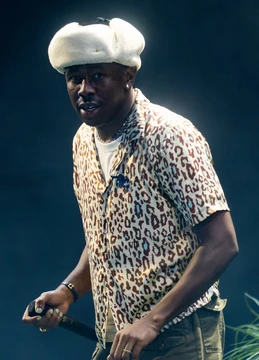
Goblin
The ugly first breath of Odd Future—raw, confrontational, and unapologetically Tyler.

Goblin is Tyler, the Creator's debut studio album and the first full-length release under the Odd Future banner, arriving in 2011 as a raw, confrontational statement from a young artist still sharpening his voice. It captures Tyler at his most unfiltered—aggressive, self-deprecating, and unapologetically explicit—before the melodic softness and genre-hopping experimentation that would define his later work.
For fans of the Odd Future era, Goblin occupies a complicated and beloved place: it is the album that proved Tyler was willing to be ugly, uncomfortable, and genuinely angry, and it set the emotional baseline from which every subsequent project would either react or build. Its production is looser, its vocal delivery more percussive, and its thematic scope narrower than what followed, yet that very roughness is what makes it feel like a genuine first breath.
- Artist
- Tyler, the Creator
- Release year
- 2011
- Label
- Odd Future Records
- Significance
- Debut studio album; first Odd Future full-length
- Genre
- Hip hop / experimental / spoken-word elements
- Notable tracks
- Bastard, Pork & Bean, Yonkers, Goblin (title track)
- Cultural context
- Early Odd Future era; pre-Whirlwind, pre-Cherry Bomb
Lore & Background
Goblin arrived in a moment when Tyler was still very young and the Odd Future collective was still finding its public identity. The album's aesthetic—goblin-mask cover art, aggressive vocal delivery, production that leans on stutters, pitch-shifted ad-libs, and a generally claustrophobic sonic palette—feels like a teenager's mixtape that accidentally became a full record. There is no smoothing, no guest-list spectacle, no melodic hook designed for radio. Instead, the listener gets Tyler's voice at its most percussive and confrontational, treating the mic almost like a second drum kit.
Thematically, Goblin circles around anger, self-loathing, and a kind of performative cruelty that Tyler has since acknowledged as a protective shell. Tracks like "Bastard" and "Pork & Bean" are deliberately abrasive, designed to provoke and to assert a kind of anti-hero identity. Yet even within that aggression there are moments of vulnerability—lines that crack, a beat that drops out, a whispered aside—that hint at the emotional range Tyler would later fully embrace in projects like Flower Boy and Igor.
The album's legacy is twofold. For the Odd Future community, it is the founding document, the record that said 'this is who we are before we were cool.' For Tyler's broader discography, it is the baseline against which every other album is measured: the before-and-after of his artistic evolution. Fans who discovered him through later, softer work often return to Goblin with a mix of discomfort and admiration, recognizing the young artist who was still figuring out what he wanted to say and how he wanted to say it.
In Their Own Story
The studio was a converted garage in Compton, the kind of space where the walls sweat and the monitors hum at a frequency that makes your teeth ache. Tyler sat cross-legged on a beanbag chair, the goblin mask still on his face, and he did not take it off. He spoke into the mic like he was talking to someone across a table who had already left. The producer—barely older than him—kept adjusting faders, trying to make the room sound less like a room and more like a place. Tyler did not care. He wanted it to sound like a room. He wanted it to sound like the night he was angry and could not sleep and the only thing that felt honest was making a sound that hurt. By the time the last take was logged, the mask was fogged, the chair was damp, and the tape had a hiss that no amount of post-production could fully kill. He kept the hiss. He always kept the hiss.
Reader's Guide
Goblin is the sound of Tyler before he was allowed to be soft, and that constraint is exactly what makes it a signature. The production choices are deliberately anti-polished: beats built from stutters, reversed vocal snippets, and a low-end that rumbles more than it kicks. There is almost no space for a traditional hook to breathe. Instead, Tyler's vocal delivery carries the rhythm—his ad-libs land like percussion, his consonants are clipped and percussive, and his pitch sits lower and more strained than the melodic singing fans would later come to expect. This is the vocal register of a teenager who has not yet discovered his falsetto, and that rawness is the album's entire identity.
The cultural moment matters. Goblin dropped when Odd Future was still a local LA collective with a cult following online, not yet the household name it would become. The album's confrontational tone—its deliberate ugliness, its refusal to be palatable—was a statement of identity for a group that defined itself in opposition to mainstream hip-hop's polish. Fans who were there remember the shock of hearing it, the way it felt like walking into a room where someone was shouting at you and you could not tell if they were mad at you or at themselves.
What Goblin shaped in Tyler's trajectory is the before-and-after. Every later album—Goblin's melodic successor Whirlwind, the genre-shattering Cherry Bomb, the vulnerability of Flower Boy—can be read as a reaction to or an evolution from the aggression codified here. When people expect Tyler to be melodic, tender, or genre-fluid, they are hearing the artist who grew past Goblin. But Goblin is the root. It is the sound of the mask coming on before the mask comes off.
Did You Know?
- Tyler has publicly expressed regret over some of the album's most explicit lyrics, acknowledging in interviews that he was very young when he wrote and recorded them.
- The goblin-mask cover art became one of the most recognizable images in early Odd Future branding and appeared on merchandise, social media avatars, and fan-made art for years.
- Goblin's production aesthetic—stuttered beats, pitch-shifted ad-libs, and a deliberately claustrophobic mix—became a template that other young producers in the Odd Future orbit emulated in their own early work.
- The album's confrontational tone stands in deliberate contrast to Tyler's later projects, making it a useful reference point for tracking his artistic evolution from aggression to vulnerability.
More in Signature Tracks & Sounds
Elsewhere in the Tyler the Creator universe
Spotted an error? Know more?
This is a living reference — every entry is fact-audited, and reader corrections feed straight into our audit queue. Suggest an edit · See this site's audit record