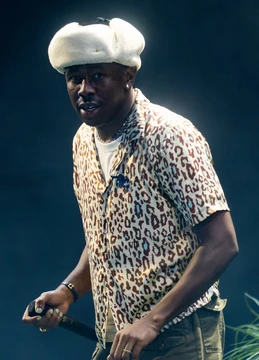
The OF Explosion
A group of LA kids with a laptop, a pink logo, and absolutely no filter changed hip-hop forever.

The OF Explosion is the fan-coined term for the raw, chaotic, and culturally seismic early period of Odd Future (OF) and Tyler, the Creator's career, roughly spanning the late 2000s into the early 2010s. It captures the moment when a group of misfit teenagers in Los Angeles—Tyler, Jaden Smith, Hodges, Left Brain, and others—began flooding the internet and underground hip-hop scene with self-released mixtapes, shock-value performances, and a DIY punk energy that had no existing category in mainstream music.
In the broader Tyler the Creator narrative, the OF Explosion is the crucible: the period of unfiltered experimentation, controversy, and community-building that forged his voice before he refined it into the more introspective, genre-fluid artist he became. Fans treat this era with a mix of reverence and affectionate distance, recognizing it as both the origin story and the rough draft of everything that followed.
- Subject
- The OF Explosion (early Odd Future era)
- Key Figure
- Tyler, the Creator (founder of Odd Future)
- Setting
- Los Angeles, California
- Affiliation
- Odd Future / OF collective
- Aesthetic
- DIY punk, shock value, pink-and-black palette
- Cultural Context
- Underground hip-hop meets internet-era virality
- Fan Significance
- Origin story; the 'before' that makes Tyler's evolution legible
Lore & Background
The OF Explosion was never a planned cultural takeover. It was a bunch of teenagers in the Inglewood and Compton area of Los Angeles who bonded over skateboarding, video games, and a shared frustration with the hip-hop establishment. Tyler, then a teenager himself, began producing beats and writing lyrics that were deliberately confrontational—using profanity, dark humor, and absurdist imagery as a shield and a weapon. The collective's early mixtapes were recorded in bedrooms and garage sessions, uploaded to the internet with little to no marketing, and spread through word-of-mouth, MySpace-era forums, and YouTube clips that accumulated millions of views almost overnight.
The visual identity of OF became as important as the music. The pink-and-black color scheme, the angular OF logo, the oversized hoodies, and the deliberately unkempt, almost aggressive presentation created a brand that felt like a skate zine crossed with a punk band's merch table. It was anti-polished, anti-corporate, and deeply rooted in a specific LA subculture that blended hip-hop, skateboarding, and internet meme culture. For a generation of kids who felt excluded from both the polished mainstream and the older hip-hop scenes, OF felt like the first door that opened.
The explosion also carried real costs. The shock-value lyrics drew heavy criticism, the group faced legal troubles and public controversies, and the pressure of sudden notoriety strained the friendships that held the collective together. Tyler himself has spoken in interviews and later projects about how the early material was a product of his age and environment, and how he grew into a more nuanced artist. Fans often frame the OF Explosion not as a single event but as a feeling—the electric, slightly dangerous sense of watching something genuinely new and uncontrolled take shape in real time.
In Their Own Story
The garage smelled like cheap incense and old sweat. Tyler sat cross-legged on a stained carpet, a laptop balanced on his knees, headphones around his neck. The beat was half-finished—something bouncy and ugly in the best way. Hodges was in the corner, editing a video on a cracked monitor, and Jaden was doing a lazy kickflip against the cinder-block wall, laughing at his own landing. Nobody was in charge. Nobody was supposed to be in charge. The OF logo was spray-painted on the inside of the garage door in faded pink, already chipping. Tyler hit record, cleared his throat, and started rapping lines that made the others wince and grin at the same time. They uploaded it that night. By morning, it had ten thousand views. By the end of the week, a kid in London had made a fan edit. Nobody in that garage understood what was happening. They just made the next one.
Reader's Guide
The OF Explosion didn't have a single ignition point; it was more like a slow fuse that finally caught. But if you're tracing the timeline, the early self-released mixtapes are where the spark lives. Tyler and the collective were putting out music with zero gatekeepers—no label, no A&R, no press kit. Just a file dropped online and a community that formed around it almost organically. What changed was the relationship between artist and audience. Tyler wasn't performing for a crowd; he was talking to a forum. The shock value, the profanity, the deliberately crude humor—it was a teenager's way of saying 'I'm here and I don't fit your box.'
Then came the live shows. The energy in those early OF sets was something fans still describe almost viscerally: a mosh pit of kids in matching hoodies, Tyler screaming into the mic, the whole thing feeling like a punk show and a hip-hop concert fused into one. The No Fear tour and the underground shows in LA became pilgrimage sites. You weren't going to a concert; you were going to a scene.
What mattered most for Tyler's trajectory was that the OF Explosion gave him permission to be ugly, to be wrong, to be loud. Every later project—whether it was the introspective turn or the genre-hopping experiments—was built on the foundation that he'd already proven he could fill a room with nothing but raw conviction and a laptop. Fans who were there remember it less as a music career and more as a summer that never ended, a group chat that never went quiet, a pink logo on a hoodie that meant you belonged somewhere for the first time.
Did You Know?
- Odd Future's early mixtapes were largely self-produced and self-distributed, bypassing traditional label infrastructure entirely and spreading primarily through internet sharing and word-of-mouth among fans.
- The distinctive pink-and-black OF visual identity was a deliberate aesthetic choice that became so recognizable it functioned as a subcultural uniform, with fans worldwide adopting the color scheme and logo as a marker o
- Tyler has acknowledged in later interviews and projects that his earliest OF-era material reflected the raw, unfiltered perspective of a teenager, and he has since evolved significantly in both lyrical content and musica
- The Odd Future collective drew from a specific Los Angeles subculture blending hip-hop, skateboarding, and internet culture, creating a hybrid identity that didn't neatly fit into any single existing genre or scene.
More in Story & Timeline
Elsewhere in the Tyler the Creator universe
Spotted an error? Know more?
This is a living reference — every entry is fact-audited, and reader corrections feed straight into our audit queue. Suggest an edit · See this site's audit record