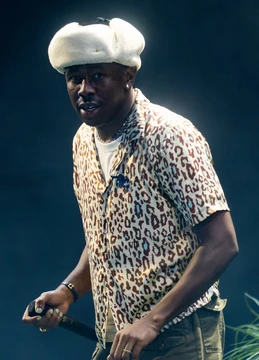
The Goblin Scream
One ugly, beautiful shriek that turned a production quirk into a generational sonic brand.

The Goblin Scream is the high-pitched, almost inhuman vocal shriek that has become one of Tyler the Creator's most instantly recognizable sonic fingerprints. Far from a single track, it is a production motif—a distorted, layered scream that punctuates songs, marks transitions, and injects a burst of chaotic energy into otherwise structured arrangements. Fans across the Odd Future and Cactus Plant Flea Market communities treat it as a kind of sonic logo: hear it, and you know whose world you've stepped into.
Rooted in Tyler's early 'goblin' persona and his love of ugly, confrontational sound design, the scream evolved from a raw, almost accidental vocal moment into a deliberate, almost ceremonial production choice. It sits at the intersection of horror-film stinger, punk energy, and internet-era absurdity, and it has shaped how listeners expect a Tyler track to feel—unpredictable, emotionally raw, and never quite safe.
- Type
- Signature vocal effect / production motif
- Artist
- Tyler Okonma (Tyler the Creator)
- Role
- Sonic punctuation, transition, and emotional spike within arrangements
- Affiliation
- Odd Future / Cactus Plant Flea Market / solo discography
- First prominent era
- Early-to-mid 2010s discography, carried through subsequent projects
- Status
- Ongoing signature element, still referenced and invoked in live sets and fan culture
Lore & Background
In the mythology Tyler built around his early career, the 'goblin' was not a mascot but a mirror. It was the part of the self that was loud, unpolished, and unapologetically confrontational—the kid who screamed into a microphone and let the distortion do the talking. The Goblin Scream crystallized that identity into a single, repeatable sound: a vocal take pushed to its upper register, drenched in saturation, and dropped into a mix like a door slamming in an empty hall. It carried the weight of every performance where the audience expected polish and got something feral instead.
Over time, the scream became a communal reference point. Listeners learned to lean in when the beat dropped out and that thin, piercing wail cut through the speakers. It functioned the way a horror-film sting functions in cinema—not to explain, but to reorient your emotional state in a fraction of a second. In live shows, the moment before the scream often carried a collective held breath, a small ritual of anticipation that turned a concert into something closer to a shared exorcism.
The deeper lore fans construct around it is that the scream is the sound of the goblin persona refusing to be fully tamed. Even as Tyler's music grew more melodic, more tender, more openly vulnerable, the scream kept showing up as a reminder that the chaos was never deleted, only edited. It is the part of the record that says: I am still the kid who used to howl at the ceiling, and I have not apologized for it.
In Their Own Story
The studio was quiet in the way that only post-midnight sessions get quiet—monitors humming, a half-empty water bottle sweating on the desk, the smell of cold coffee and warm tape. Tyler sat cross-legged on the carpet, headphones around his neck, staring at the waveform on the screen like it owed him money. He hit record. He didn't think about pitch or form. He just opened his mouth and let the sound come out the way it came out, thin and ragged and a little too loud, the kind of noise that makes the engineer wince and smile at the same time. He stopped. Played it back. The compressor kicked in, the saturation turned the high end into a wire, and for a half-second it sounded like something small and feral was screaming from inside a metal box. He nodded once, hit save, and said nothing. The engineer knew better than to ask. Some sounds don't need a name. They just need to be in the mix, waiting for the exact moment the beat goes silent and the room holds its breath. That moment was coming. It always was.
Reader's Guide
The Goblin Scream works as a Tyler signature because it is, at its core, a single emotional gesture compressed into a sound. Production-wise, it leans on extreme high-end saturation, a narrow frequency band that cuts through dense mixes, and a very short decay—more of a stab than a sustain. The vocal itself is unpolished: you can hear the breath, the slight crack, the fact that it was not performed for beauty but for impact. That imperfection is the point. In a landscape of over-produced vocal effects, the scream feels like a hand grabbing your collar.
The cultural moment it landed in matters. Tyler was building a brand around the 'goblin'—ugly, loud, unapologetic—while the broader hip-hop and internet culture was moving toward either hyper-polished trap or earnest vulnerability. The scream occupied a third lane: confrontational but playful, ugly but intentional, a sound that said 'this is a joke and this is not a joke simultaneously.' It gave listeners permission to feel something sharp without the weight of a full lyrical statement.
What it shaped in audience expectation is the idea that a Tyler track can pivot on a single non-verbal moment. Listeners now half-consciously listen for the silence before the scream, the beat clearing, the tiny intake of breath. It turned a production choice into a narrative beat, and that is what makes it a signature rather than just an effect.
Did You Know?
- The 'goblin' identity predates the scream as a production element; the visual and verbal branding of goblinhood in Tyler's early community work laid the emotional groundwork that the sound later codified.
- In live performances, the moment before the scream often features a brief, deliberate silence in the backing track, turning the audience's anticipation into part of the sound design itself.
- The scream has been widely imitated and parodied in fan-made edits, memes, and reaction content, cementing its status as one of the most recognizable micro-moments in modern hip-hop production.
- Despite Tyler's later projects leaning into softer, more melodic territory, the scream has continued to appear as a recurring motif, functioning almost like a sonic watermark that ties disparate eras of his catalog toget
More in Signature Tracks & Sounds
Elsewhere in the Tyler the Creator universe
Spotted an error? Know more?
This is a living reference — every entry is fact-audited, and reader corrections feed straight into our audit queue. Suggest an edit · See this site's audit record