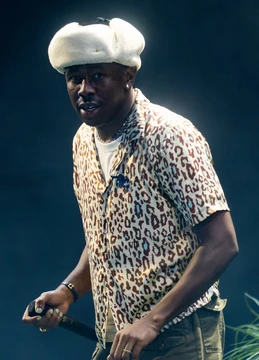
Odd Future Formation
A bunch of high-school outcasts decided the world wasn't big enough, so they built their own.

Odd Future (full name: Odd Future Wolf Gang Kill Them All, often abbreviated OFWGKTA) is the creative collective, record label, and cultural movement founded by Tyler Okonma—known to the world as Tyler the Creator—during his high school years in Los Angeles. What began as a small group of teenagers making music in bedrooms and garages grew into one of the most influential independent artist collectives of the 2010s, spanning hip-hop, film, fashion, and visual art.
In the broader Tyler the Creator universe, the formation of Odd Future is the foundational event: the moment a restless teenager decided that the music industry's gatekeeping wasn't for him, and that a group of misfits could build their own world from scratch. Every album, every movie, every clothing line that followed traces its DNA back to this origin story of self-sufficiency, chaotic energy, and an almost reckless belief that the group could out-create the system that had ignored them.
- Founder
- Tyler Okonma (Tyler the Creator)
- Affiliation
- Independent artist collective and label
- Based in
- Los Angeles, California
- Early core members
- Tyler, YG, Hodgy Beats
- Disciplines
- Music, film, fashion, visual art
- Status
- Active as a collective/label
Lore & Background
The story fans tell about Odd Future's origins is almost mythic in its simplicity. Tyler, still a teenager in the Los Angeles suburbs, was making music on a laptop, trading beats with friends, and feeling the friction of a music scene that didn't quite fit him. He wasn't trying to start a label or a movement; he was trying to get his friends to take his songs seriously. YG, Hodgy Beats, and a rotating cast of local artists became the first circle. They made music together, filmed absurd skits for a YouTube channel, and built a shared identity around the name 'Wolf Gang'—a pack that moves together, barks at everything, and answers to no one.
What made the formation feel revolutionary to fans wasn't just the music. It was the refusal to separate disciplines. Tyler directed short films. The group designed their own visuals. They booked their own shows, recorded in whatever room was available, and released music on their own terms. In an era when independent artists were still fighting for shelf space, Odd Future simply ignored the shelf. The collective became a proving ground: a place where a kid could go from bedroom producer to headlining a festival, where fashion drops were as anticipated as album releases, and where the line between 'artist' and 'brand' was deliberately, joyfully blurred.
For the fan community, the formation era carries a particular emotional weight. It represents the 'before'—the raw, unpolished, sometimes painful period before Tyler's later evolution toward vulnerability and self-care. Fans revisit those early tracks and videos not just for the music but for the feeling: the electricity of a group that had nothing to lose and everything to prove, running on caffeine, spite, and an almost irrational faith in each other.
In Their Own Story
The garage smelled like cheap coffee and the ozone hum of a laptop left running too long. Tyler sat cross-legged on a concrete floor, headphones around his neck, muttering into a mic that cost less than a tank of gas. YG was in the corner, half-asleep, half-listening, occasionally throwing a line over his shoulder that made Tyler flinch and then laugh. Hodgy was on the phone, arguing with someone about a show they hadn't booked yet. Outside, the LA afternoon stretched long and golden, indifferent to the fact that four kids in a driveway were about to make something that would, in a few years, have a name that people screamed in arenas.
Nobody had a plan. That was the point. Tyler hit record, and the tape—or the file, whatever—just kept rolling while they talked, rapped, argued, and occasionally went silent long enough for the hum of the refrigerator to fill the space. He'd delete most of it later. He'd keep the two minutes where YG's voice cracked on a hook and nobody said anything. That was the seed. That was the whole weird, beautiful, unrepeatable seed of a collective that was supposed to be just a Thursday-night thing and never, ever stopped being one.
Reader's Guide
Picture this: you're seventeen, you're in a California suburb, and the music you're making in your bedroom feels like it's from a different planet than the stuff on the radio. You've got two friends who get it, a laptop that overheats if you push it, and this electric, almost aggressive conviction that you don't need permission. That's the Odd Future formation, and for fans who were there in the early YouTube days, it hit like watching a fire start in real time. You could see the sparks—Tyler's chaotic energy, YG's smooth confidence, Hodgy's offbeat humor—and you could feel the heat before the whole thing roared.
What changed wasn't just that a new name appeared in the hip-hop landscape. It was the *model*. A group of kids, self-producing, self-directing, self-distributing, treating music and film and fashion as one continuous creative act rather than separate industries. For a generation of listeners who felt locked out of the 'industry,' it proved you could build the room yourself. The moment mattered because it shifted Tyler's trajectory from 'promising local artist' to 'the person who makes the rules,' and it gave a whole community of fans a shared origin myth they could point to and say, *this is where it started, and it started because a bunch of kids refused to wait for someone to let them in.*
Did You Know?
- The full name Odd Future Wolf Gang Kill Them All (OFWGKTA) was a deliberately over-the-top, tongue-in-cheek title that reflected the collective's irreverent, boundary-pushing identity from day one.
- Before Odd Future was a label or a brand, it was essentially a YouTube channel and a group chat—Tyler and his friends posting skits and tracks online with no management, no marketing team, and no expectation of scale.
- The collective's early aesthetic was intentionally chaotic and DIY: hand-drawn logos, low-budget videos, and a visual identity that looked like it was made in a bedroom, which became part of its charm and authenticity.
- Odd Future's formation gave several of its members—YG, Hodgy Beats, and others—a platform and a shared creative space that allowed them to develop their individual careers while remaining part of a larger family.
More in Story & Timeline
Elsewhere in the Tyler the Creator universe
Spotted an error? Know more?
This is a living reference — every entry is fact-audited, and reader corrections feed straight into our audit queue. Suggest an edit · See this site's audit record