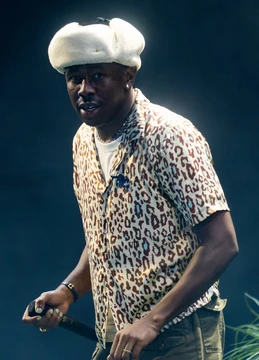
Nigo
The Japanese design god who taught a generation that a monkey logo could carry the weight of a culture.

Nigo (Tomoaki Nagao) is a Japanese fashion designer, artist, and cultural polymath whose work sits at the intersection of streetwear, art, and pop culture. Within the Tyler the Creator universe, he functions as a kindred creative spirit from across the Pacific—a figure who helped Tyler understand that fashion is not just clothing but a language, a worldview, and a community. His brands, A Bathing Ape (BAPE) and later Human Made, became touchstones for Tyler's own aesthetic evolution and his broader creative philosophy of mixing high and low, play and craft.
For fans of the Tyler ecosystem, Nigo represents the bridge between the Japanese streetwear tradition that shaped a generation of artists and the American hip-hop and design scene Tyler helped redefine. Their collaboration is less a business transaction and more a mutual recognition: two outsiders who built empires from scratch, who treat a t-shirt with the reverence others reserve for a painting, and who understand that culture is built in the spaces between disciplines.
- Real name
- Tomoaki Nagao
- Nationality
- Japanese
- Primary roles
- Fashion designer, artist, creative director
- Founding brands
- A Bathing Ape (BAPE), Human Made
- Relationship to Tyler
- Fashion collaborator and creative ally
- Status
- Active
Lore & Background
In the mythology of Tyler's creative world, Nigo occupies the role of the elder craftsman who arrived from a different continent with a different grammar of cool. Where Tyler's early work was raw, confrontational, and deliberately unpolished, Nigo's influence introduced a counterpoint: the idea that meticulous construction, playful iconography, and cultural storytelling could coexist with edge and irreverence. The ape head, the camo, the hand-knitted textures of Human Made—these became visual vocabulary that Tyler absorbed and reinterpreted in his own brand language.
The relationship between Tyler and Nigo is often described by fans as one of mutual respect between two people who refused to be boxed in. Nigo moved between fashion shows, film productions, art installations, and toy design with the same ease Tyler moved between music, fashion, film, and comedy. Neither saw those boundaries as real. In the Tyler universe, Nigo is the proof that a designer can be as loud, as weird, as genuinely funny as a rapper, and that a rapper can take a garment as seriously as a sculptor takes clay.
Their collaborations carry a particular energy that fans recognize: a sense of two people who have already said the important things in their own languages and are now translating for each other. The result is work that feels neither purely Japanese nor purely American, but something in the fertile, slightly chaotic middle where the best culture tends to live.
In Their Own Story
The studio smelled like fresh dye and cold coffee. Nigo stood at the far end of the room, turning a chunky hand-knitted sweater in his hands, his expression doing that thing where he's half-smiling and half-squinting like he's reading a very confusing menu. Tyler was on the floor, cross-legged, sketching something on a napkin with a marker that was already running out of ink. They'd been going back and forth for three hours about the color of a single thread. Nigo held up a swatch—something between mustard and the color of a bruise. Tyler pointed at it without looking up. Nigo held up another. Tyler nodded. Neither of them spoke for a while. Outside, Tokyo traffic hummed its low, endless chord. The sweater would ship in six weeks. They both knew that. They both knew it would sell out in four minutes. Neither of them cared about that part. They cared about the thread. They always cared about the thread.
Reader's Guide
If you've followed Tyler's fashion evolution from the early Odd Future chaos to the considered, almost architectural pieces of Golf Wang, Nigo's fingerprints are everywhere, even when his name isn't on the label. He's the reason Tyler treats a hoodie like a short story—every stitch a sentence, every logo a character.
Their joint work has spanned capsule collections, runway appearances, and shared creative sessions that fans describe as less like a business meeting and more like two kids in a room who can't stop making things. Nigo brought Tyler into the world of Japanese craft traditions—hand-knitting, vintage denim, the almost obsessive attention to fabric weight. Tyler brought Nigo into the world of hip-hop's visual language, its humor, its willingness to be ugly on purpose.
Inside the Odd Future / Golf Wang ecosystem, Nigo is the friend who slides into the group chat with a photo of a weird fabric he found in a Kyoto market and three exclamation points. He's the one who makes Tyler say 'okay that's actually insane' and then immediately start reworking a whole collection around it. Fans who've been around since the early days will remember the specific energy of those cross-pollination moments—the way a Japanese streetwear sensibility and an American hip-hop sensibility crashed into each other and produced something neither could have made alone.
He's not a musician. He's not in the albums. But if you understand why Tyler's fashion feels the way it does, why the humor and the craft coexist without one undercutting the other, Nigo is part of the answer.
Did You Know?
- Nigo's original brand, A Bathing Ape, was founded in the early 1990s in Tokyo and became one of the most influential streetwear labels in the world before most Western audiences even knew the term 'streetwear' existed.
- Beyond fashion, Nigo has worked in film, art installation, and toy design—making him one of the few figures who moves between those worlds with genuine fluency rather than as a one-off cameo.
- Tyler has been a long-standing admirer of Japanese streetwear culture, and Nigo's work sits at the center of that tradition, making their creative overlap feel less like a random pairing and more like a natural convergen
- Nigo's Human Made label is known for its hand-knitted sweaters and playful, almost cartoonish iconography—a design philosophy that resonates strongly with Tyler's own preference for mixing high craft with low, approachab
More in Collaborators & People
Elsewhere in the Tyler the Creator universe
Spotted an error? Know more?
This is a living reference — every entry is fact-audited, and reader corrections feed straight into our audit queue. Suggest an edit · See this site's audit record