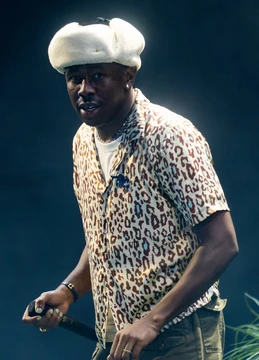
Wolf Era
The year Tyler stopped barking and started howling something quieter.

The Wolf Era refers to the creative period surrounding Tyler, the Creator's third studio album, *Wolf*, released in 2013. It stands as one of the most discussed turning points in his career, marking a decisive pivot away from the confrontational, shock-tinged comedy of his earlier OFG days toward a more tender, melodic, and self-examining sound. Fans often point to this era as the moment Tyler stopped performing a character and started writing himself into the record.
Culturally, the Wolf Era sits at the crossroads of two identities: the loud, chaotic Odd Future kid and the emerging solo artist willing to be vulnerable on a hook. The album's production leans into R&B inflections, layered vocals, and a restrained palette that felt almost like a held breath after years of screaming. For the community that had followed him since the early mixtapes, the shift was disorienting and, for many, deeply moving.
- Subject
- Wolf Era (album *Wolf*)
- Artist
- Tyler, the Creator
- Release year
- 2013
- Album number
- Third studio album
- Label
- Odd Future / Columbia Records
- Notable collaboration
- Kendrick Lamar on "Loyalty"
- Tonal shift
- Aggressive/comedic → melodic/introspective
Lore & Background
The Wolf Era is inseparable from Tyler's personal reckoning with the persona he had built over the preceding years. The early Odd Future catalog thrived on provocation, dark humor, and a kind of performative cruelty that functioned as armor. By the time *Wolf* entered production, that armor had begun to chafe. The album's lyrical content, as widely discussed by fans, circles themes of loneliness, the cost of fame, the difficulty of trusting people after public humiliation, and a desire to be seen rather than feared. The title itself—Wolf—carries the duality of the animal: pack-bonded yet solitary, capable of tenderness and of violence.
Musically, the era is defined by a production philosophy that prioritizes space over density. Where earlier records layered chaotic samples and shouted ad-libs, *Wolf* leans on clean vocal stacks, soft synth pads, and a restrained drum feel that lets Tyler's melodic writing breathe. The R&B influence is not a genre switch so much as a permission slip: it allowed Tyler to sing, to harmonize with himself, to let a beat sit under a verse instead of bulldozing through it. The collaboration with Kendrick Lamar on "Loyalty" became a cultural touchstone, pairing two artists who had been circling each other's orbits since the early 2010s in a track that felt like a mutual exhale.
For the fanbase, the Wolf Era also carried a visual and fashion language that was noticeably calmer. The wardrobe shifted toward muted tones, simpler silhouettes, and a less confrontational stage presence. It read like a man trying on a quieter version of himself and deciding, tentatively, to keep it. The era became a reference point in every subsequent discussion of Tyler's growth, a before-and-after hinge that fans still return to when tracing his arc.
In Their Own Story
The studio was dim, lit only by the amber glow of a monitor and the soft blue of a phone screen face-down on the desk. Tyler sat cross-legged on a couch that was too small for him, headphones around his neck, a half-empty glass of water sweating condensation onto the cushion. The beat was already laid—something sparse, a kick that hit like a heartbeat, a pad that swelled and receded like tide. He'd been sitting in this exact spot for three hours, listening to the same thirty seconds of his own voice loop back at him, searching for the line that made it sound like he wasn't performing. Outside, the city hummed its indifferent hum. He pressed record, cleared his throat, and sang the hook one more time, softer this time, like he was talking to someone in the next room who might not be there. The engineer nodded. They both knew it was the take.
Reader's Guide
Think about where you were in 2013. For a lot of us, Tyler was still the kid who made us flinch, who turned a show into a controlled chaos event, who made us laugh at things that weren't really funny. Then *Wolf* dropped and the room went quiet. Not in a "did the Wi-Fi cut out" way. In a "oh, he's actually talking to us" way.
What changed wasn't just the sound. It was the posture. The lyrics stopped being a monologue shouted into a void and started sounding like a conversation with a specific, unnamed friend. The production got air in it. The fashion got softer. The whole package said: I'm still here, I'm still a little feral, but I'm not going to bite unless you reach for my throat first.
Fans experienced it in real time. The early streams, the forum threads debating whether this was a phase, the slow build of "Are We Still Friends?" becoming a radio staple that felt almost accidental for someone who had spent years being the antithesis of radio. The Kendrick feature on "Loyalty" landed like a handshake between two people who'd been sizing each other up for years.
It mattered because it proved the persona wasn't the whole person. And for a community that had bonded over the persona, that was both a gift and a small grief. We got to watch someone grow up in public, and for once, the growth was gentle.
Did You Know?
- The album's title track and overall aesthetic lean into the duality of the wolf as both pack-animal and solitary creature, mirroring Tyler's own tension between his Odd Future collective identity and his solo artistic vo
- "Loyalty," featuring Kendrick Lamar, became one of the most frequently cited collaborations of the early 2010s hip-hop landscape and is often referenced in discussions of the West Coast sound's evolution during that peri
- The Wolf Era's production philosophy—prioritizing vocal layering, restrained drums, and R&B-inflected pads—became a template Tyler would revisit and refine in later projects, making it a foundational blueprint for his su
- The visual and fashion language of the era, with its muted color palettes and simpler silhouettes, marked a visible departure from the more chaotic, logo-heavy Odd Future aesthetic and influenced a broader shift in how T
More in Story & Timeline
Elsewhere in the Tyler the Creator universe
Spotted an error? Know more?
This is a living reference — every entry is fact-audited, and reader corrections feed straight into our audit queue. Suggest an edit · See this site's audit record