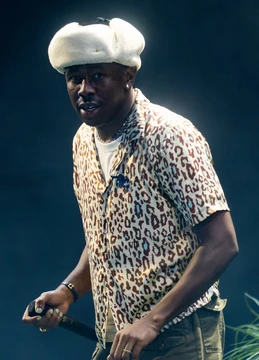
Virgil Abloh
The architect who gave Tyler's flowers a skeleton and a skyline.

Virgil Abloh (1980–2021) was the architect-turned-designer who reshaped global fashion and, in the Tyler the Creator universe, served as one of the most trusted creative confidants in the OG circle. A Harvard-trained architect who founded Off-White and later became Louis Vuitton's men's creative director, Virgil brought a rigorous, conceptual eye to Tyler's visual world—most memorably through the *Flower Boy* era, where his design sensibility shaped the album's artwork, promotional imagery, and the broader aesthetic language of that period.
His relationship with Tyler went far beyond a professional collaboration. Virgil was the friend who sat in the studio, the one who understood that a color palette could carry as much emotional weight as a melody. His sudden passing in November 2021 left a visible, aching absence in the collective, and Tyler's public grief became a shared moment for the entire fanbase.
- Role
- Fashion designer, artist, close friend & visual collaborator
- Affiliation
- Off-White; Louis Vuitton (Men's); Tyler's OG circle
- Notable joint project
- Flower Boy (2017) album artwork & visual campaign
- Status
- Deceased (November 2021)
- Discipline
- Architecture (Harvard GSD), industrial design, fashion
- Known for
- Founding Off-White; redefining luxury menswear; Tyler's visual ecosystem
Lore & Background
In the mythology of the OG collective, Virgil occupies a role that is almost mythic: the one who made the impossible look inevitable. Where Tyler's creative world is often described as a fever-dream of color, sound, and raw emotion, Virgil was the structural engineer who ensured the dream had load-bearing walls. He didn't just decorate Tyler's vision—he gave it geometry, proportion, and a vocabulary that could travel from a bedroom studio in Los Angeles to a runway in Paris without losing a single ounce of its soul.
Their friendship, as fans understand it, was built on mutual respect that cut across perceived hierarchies. Virgil, the Harvard-trained architect who had already conquered the fashion world, treated Tyler's chaotic, self-taught genius with the same gravity he brought to a Louis Vuitton collection. And Tyler, in turn, treated Virgil's design philosophy not as a separate discipline but as another instrument in the band. In the *Flower Boy* era, that synthesis was most visible: the album's visual language blended Virgil's clean, conceptual design instincts with Tyler's emotional, almost childlike palette, producing imagery that felt both architectural and tender.
After Virgil's death in late 2021, the collective's energy shifted in ways fans could feel but not always name. Tyler's public tributes were sparse but searing, and the silence that followed carried the weight of a friend who had been, for years, the one who could say 'that's not right, let's fix it' without anyone flinching. In fan discourse, Virgil is often remembered as the quiet anchor—the one who made the loudest, most unfiltered creative force in the room feel safe enough to be loud.
In Their Own Story
The studio was three a.m. and the walls were still wet with paint—some shade of lavender that neither of them could name. Virgil stood with his arms crossed, studying the canvas Tyler had just dragged into the room. It was a mess. Beautiful, but a mess. He didn't say 'it's good.' He said, 'What's the load-bearing color?' And Tyler, who would have bristled at that question from anyone else, laughed, wiped his hands on his jeans, and said, 'I don't know. What do you think it is?' They stood there for twenty minutes, arguing about whether the sky in the painting should be a structural element or just a feeling. Virgil won. The sky became a grid. And the album cover, when it finally shipped, made the whole world feel like it was looking at a cathedral made of taffy. Tyler never thanked him in a press release. He just kept the grid. And Virgil kept the taffy. They both kept both.
Reader's Guide
If you've been in the Tyler fandom long enough, you know Virgil wasn't just 'the guy who did the album cover.' He was the friend who showed up to the studio in a perfectly tailored Off-White jacket, sat on the couch, and critiqued a mix like a structural engineer reviewing a bridge. He made Tyler feel like his visual ideas were worthy of the same rigor as his music, and that mattered more than any single deliverable.
His most visible contribution to the canon is the *Flower Boy* (2017) visual package—album art, promotional stills, the whole aesthetic architecture of that era. The clean lines meeting the soft, almost childish color choices became the visual signature of that period, and fans still reference it when they talk about 'the Virgil era' of Tyler's design language. Beyond that single project, Virgil's influence seeped into Tyler's broader fashion choices, his comfort with high-fashion collaboration, and the collective's general understanding that design and music weren't separate crafts.
He was OG. Not a contractor, not a consultant. A friend who happened to be the most important designer on the planet. And when he was gone, the studio felt like it was missing a load-bearing wall. Tyler's grief was public, short, and absolute. The collective's energy shifted. Fans felt it in the silence between projects. You don't replace a Virgil. You just keep the grid, and you keep the taffy, and you hope the cathedral holds.
Did You Know?
- Virgil was a trained architect with a degree from Harvard's Graduate School of Design before he ever touched a fashion collection, which is why his design approach to Tyler's visuals felt structural rather than decorativ
- He founded Off-White in the early 2010s and later became Louis Vuitton's men's creative director, making him the first Black creative director in the house's history.
- Tyler's public tribute after Virgil's death in November 2021 was notably brief and personal, and the fan community treated the period afterward as a shared, quiet mourning.
- In the OG collective's internal culture, Virgil was known for being the one who could push back on a design choice without it becoming a confrontation—fans often describe him as the 'structural friend' who kept the creat
More in Collaborators & People
Elsewhere in the Tyler the Creator universe
Spotted an error? Know more?
This is a living reference — every entry is fact-audited, and reader corrections feed straight into our audit queue. Suggest an edit · See this site's audit record