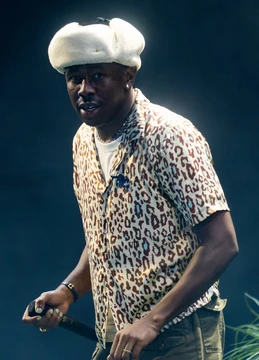
J. Cole
The steady voice of craft and kindness in Tyler's orbit, a friend who never needed the spotlight to matter.

J. Cole (Jermaine Cole) is a rapper, singer, songwriter, and the founder of Dreamville Records, and within the Tyler the Creator universe he occupies the role of a deeply respected peer, close friend, and kindred spirit in the world of hip-hop. He is the artist Tyler has publicly cited as someone who showed genuine warmth and respect during a period when Tyler was still finding his footing in the industry, and their bond has persisted through every major era of Tyler's career.
In fan discussions of Tyler's creative ecosystem, J. Cole is often referenced not as a frequent musical collaborator on track features, but as a foundational personal connection—a figure whose artistry, work ethic, and integrity Tyler admires and who has served as a grounding presence amid the whirlwind of Tyler's evolving aesthetic and public life.
- Role
- Rapper, singer, songwriter, record label executive
- Affiliation
- Dreamville Records (founder)
- Relationship to Tyler
- Close friend, mutual respect, personal mentorship
- Hometown
- Fayetteville, North Carolina
- Known for
- Lyrical depth, storytelling, entrepreneurial vision in hip-hop
- Status
- Active artist and label head
Lore & Background
In the sprawling, color-saturated mythology of Tyler the Creator's world—where eras shift like seasons and the tone swings from gothic to pastoral to electric—J. Cole exists as the constant. Fans who follow Tyler's interviews, social media, and live performances over the years have watched the same quiet, genuine warmth appear whenever J. Cole's name comes up. Tyler has spoken in interviews about how, during the earlier, more confrontational chapters of his career, J. Cole was among the first established artists to extend real, unguarded friendship rather than transactional industry politeness. That early grace became a thread running through Tyler's later, more introspective work.
Their dynamic in the broader hip-hop landscape is one of parallel respect: two artists who approach the craft with different tools—Tyler through sonic experimentation, visual spectacle, and emotional rawness; Cole through dense lyricism, narrative architecture, and a commitment to the song as a complete, self-contained world. Fans often note that when Tyler is in a reflective, melodic headspace (the Flower Boy and Igor eras), the emotional register feels closer to Cole's own, and the two artists seem to orbit a shared frequency of vulnerability without losing their distinct voices.
Dreamville Records, Cole's label, has become a touchstone in fan conversations about what an artist-run collective can look like when built on genuine creative kinship rather than commercial calculation. Tyler, who built his own label and creative family (OPTI, later the broader Tyler, the Creator collective) on similar principles of loyalty and shared vision, has a natural kinship with that model. The two labels rarely intersect commercially, but the philosophy behind them resonates, and fans love to draw those parallels.
In Their Own Story
The studio is quiet in the way it only gets at 2 a.m.—the kind of silence that means three hours of work are already behind them. Tyler is sprawled on a couch, headphones around his neck, staring at a wall where a half-finished canvas hangs crooked. J. Cole sits cross-legged on the floor, not on a chair, not on a producer's stool, just on the carpet, scrolling through a phone with that half-smile he gets when something makes him think. No one is performing. No one is curating a moment for a camera. Tyler says something low, almost a question, and Cole tilts his head, listens the way he always does—fully, without interrupting—and then says four words that make Tyler laugh so hard he has to press his palms against his eyes. Outside, the city hums its indifferent hum. In here, it's just two friends who figured out, years ago, that the best creative conversations happen when nobody is trying to be an artist.
Reader's Guide
If you've followed Tyler since the GOO days, you know that J. Cole's presence in his life is less about a track credit and more about a person. Tyler has talked in interviews about how Cole was one of the first big-name artists to just... be a friend, to call him, to hang out without an angle. That early kindness stuck. Through the Bastard era, the Wolf era, the Cherry Bomb pivot, the Flower Boy renaissance, and into the Igor and Call Me If You Get Lost chapters, Cole's name keeps surfacing in Tyler's orbit—not as a producer, not as a featured artist on a hit single, but as the guy Tyler texts, the friend he's seen at the same events, the peer he respects without needing to perform that respect on camera.
Their creative philosophies are different but complementary. Tyler builds worlds—sonic, visual, narrative—where the listener is dropped into an experience. Cole builds architectures—verse structures, narrative arcs, thematic through-lines—where the listener is guided through a thought. Tyler's fans who love the emotional rawness of Flower Boy or the pastoral melancholy of Igor often find a kindred spirit in Cole's storytelling, and that overlap is a big part of why the two names get mentioned together in fan spaces.
In the Tyler universe, J. Cole is the steady friend at the back of the room. He's not the loudest voice, not the most visually striking presence, but he's the one who's been there since before the colors got bright, and he's still there. And for a fan who's been riding Tyler's journey since the early days, that consistency is its own kind of love story.
Did You Know?
- Tyler has publicly referenced J. Cole as one of the first major artists to extend genuine, unguarded friendship during his earlier, more confrontational career phase, a moment fans often cite as a turning point in Tyler'
- J. Cole's Dreamville Records operates on a philosophy of artist ownership and collective loyalty that mirrors, in spirit, the way Tyler built his own label and creative family, even though the two collectives rarely inte
- Their friendship has spanned nearly every major era of Tyler's career, from the darker, more aggressive early work through the melodic, introspective Flower Boy and Igor periods, making Cole one of the few constant perso
- In fan communities, the Tyler–Cole dynamic is often described as the 'quiet friendship'—a bond defined by mutual respect and low-key loyalty rather than high-profile collaborations, which fans find refreshing in an indus
More in Collaborators & People
Elsewhere in the Tyler the Creator universe
Spotted an error? Know more?
This is a living reference — every entry is fact-audited, and reader corrections feed straight into our audit queue. Suggest an edit · See this site's audit record